1854 G25C BG-104 (Regular Strike)
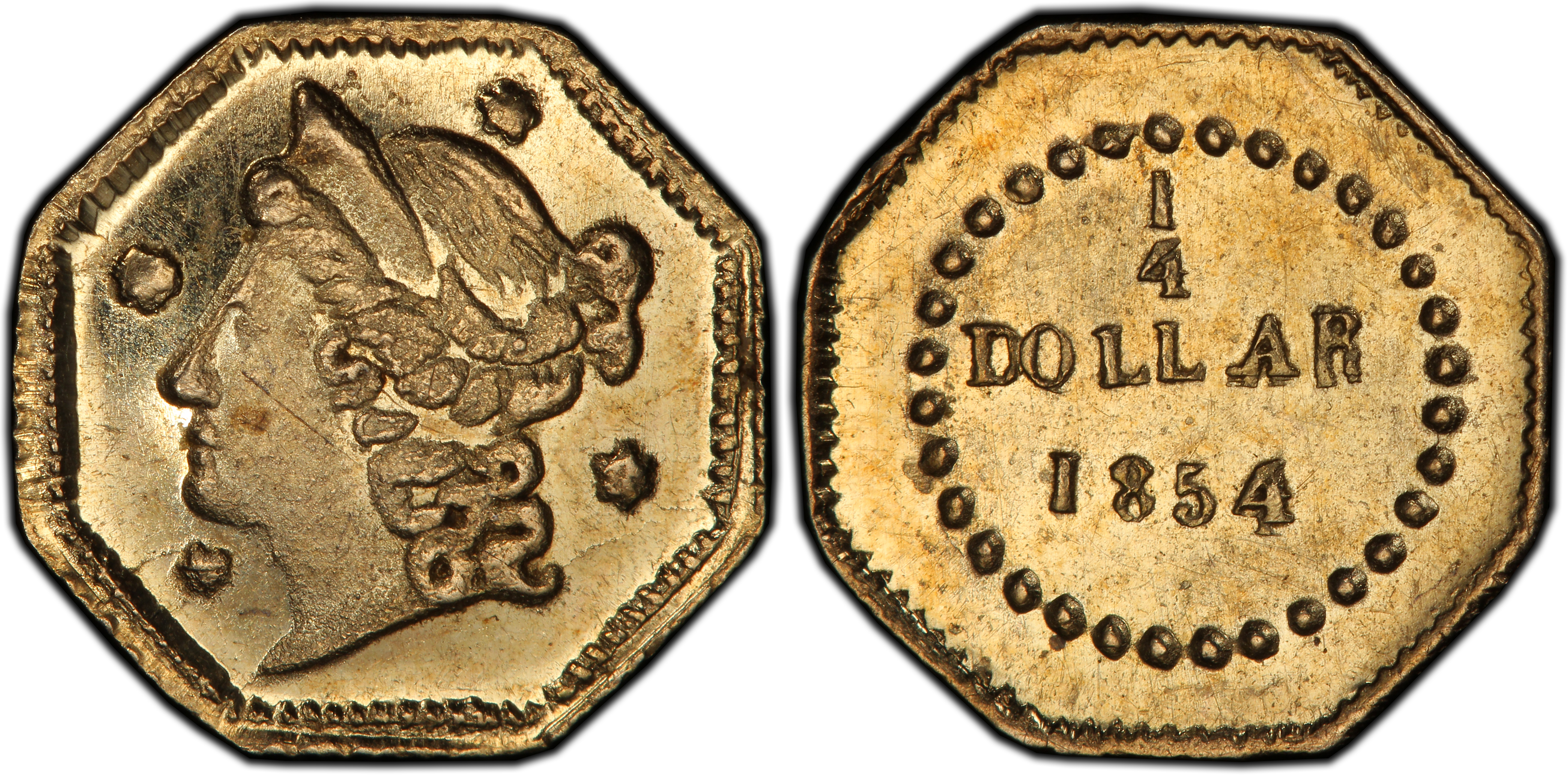
Obverse & Reverse
The 1854 Octagonal 25 Cents, cataloged as Breen-Gillio 104, is a quintessential artifact from the first period of private coinage in Gold Rush California. The discovery of gold at Sutter's Mill in 1848 triggered an unprecedented migration, flooding the region with over 300,000 people by the mid-1850s. This population explosion created a vibrant, cash-based economy that was immediately crippled by a severe shortage of circulating small-denomination coinage. The nearest U.S. Mint was in Philadelphia, an arduous and dangerous journey away. While larger transactions could be settled with gold dust, pinches, or large private ingots, everyday purchases for essentials like a meal, a drink, or a shave were exceedingly difficult. Into this monetary vacuum stepped numerous private minters, primarily jewelers and assayers in burgeoning San Francisco, who possessed the skills and raw materials to strike coins. These 'Period One' issues (1852-1856) were created to directly address the currency shortage and were intended for actual circulation. The BG-104 was struck by the firm of Frontier & Deviercy, French jewelers who were among the most prolific producers of these fractional pieces. Unlike later souvenir issues, these early coins were a genuine, if unofficial, part of the region's money supply. However, they were not without controversy. Most fractional gold pieces were notoriously underweight, containing less gold than their face value suggested. This practice, while profitable for the minters, drew the ire of authorities and merchants, especially after the San Francisco Mint began full-scale operations in 1854. The increasing availability of federal coinage, combined with pressure from law enforcement who viewed private minting as a violation of federal law, led to the decline of these Period One issues by 1857. The BG-104's existence is a direct testament to the entrepreneurial, and occasionally opportunistic, spirit that defined the era—a tangible solution to an economic crisis on the American frontier.
Associated EventCalifornia Gold Rush
Reason For MintingTo alleviate a severe shortage of small-denomination coinage for daily commercial transactions in Gold Rush California.
Minter HistoryPierre Frontier and Eugene Deviercy were French jewelers operating in San Francisco during the 1850s. Like many of their contemporaries, they applied their metallurgical skills to the lucrative business of private coining to meet the region's desperate need for small change. Their firm was a significant producer of 'Period One' fractional gold, striking a variety of octagonal and round quarter, half-dollar, and dollar denominations. The designs were often crudely executed but served their purpose in commerce. The partnership's operations in private coinage ceased around 1856 as federal coins from the newly established San Francisco Mint became plentiful and legal scrutiny of underweight private issues intensified.
Historical SignificanceThe BG-104 is a key representative of the 'Period One' California fractional gold series, which served as a necessary, privately-produced circulating medium during the region's formative Gold Rush years. It embodies the economic chaos and entrepreneurial solutions that arose before federal infrastructure could be fully established on the West Coast.
BG-104
Denomination25 Cents
Minting Period1854
Assayer/MinterFrontier & Deviercy
Geographic OriginSan Francisco, California
Obverse DescriptionA crude, large Liberty Head facing left, her hair tied in a bun. She is surrounded by thirteen stars, which are often poorly formed or blob-like, especially in later die states. The overall design is a rudimentary imitation of the official U.S. gold dollar.
Obverse Inscription[No lettering, only the Liberty Head portrait and 13 stars.]
Reverse DescriptionThe denomination '1/4 DOLLAR' and the date '1854' are enclosed within a simple wreath of two branches tied by a bow at the bottom. The inscription 'CALIFORNIA GOLD' appears along the upper periphery, outside the wreath.
Reverse InscriptionCALIFORNIA GOLD / 1/4 / DOLLAR / 1854
CompositionGold
Stated Fineness Actual FinenessVariable, typically made from native California gold alloyed with silver, resulting in a lighter color than federal issues.
EdgePlain
Unknown
Survival EstimateFewer than 75 believed to exist.
Rarity ScaleHigh R-5 (31-75 known)
BG-104 is highly sought after as a genuine 'Period One' circulating issue from a known private minter. Its octagonal shape, clear date, and historical importance as a solution to the Gold Rush currency crisis make it a tangible link to one of America's most romanticized eras.
Key VarietiesThe primary variety is the regular business strike. The same obverse die was used for the BG-102 (dated 1853) and BG-103 varieties, and it often shows progressive wear and degradation, with the stars becoming misshapen 'blobs' in later strikings of BG-104. No proof or presentation strikings from the original period are known to exist.
Authentication TipsKey diagnostics for an authentic BG-104 include a prominent repunched '4' in the date '1854' and a distinctively tall 'R' in the word 'DOLLAR' on the reverse. The reverse die is unique to this variety. The obverse die is shared with BG-102 and BG-103 and often shows significant wear. Be wary of modern replicas which often have a soapy, cast-like appearance and incorrect weight or specific gravity. Genuine pieces have a sharp, if somewhat crude, hand-struck quality.
Shopping ConsiderationsA premium quality example for its grade will exhibit a bold strike, especially on the central Liberty portrait and the date. Many examples are weakly struck, particularly around the periphery. Look for minimal surface impairments; these tiny, soft gold coins were easily damaged. Original, uncleaned surfaces with some remaining luster command a significant premium. Avoid examples that are described as 'cleaned' or have evidence of tooling or harsh abrasions, which are common problems for this series. Check for planchet irregularities, as these were common on privately minted coinage and are not necessarily a detriment.
A coin's grade is its condition, rated on a 1-70 scale. For rare coins, this is the most critical factor in determining value, as a tiny difference in preservation can mean a huge difference in price.
Relevant Grade TypesAll original examples of BG-104 are business strikes intended for circulation and are found in Circulated (1-58) and Mint State (MS, 60-70) grades. No Proofs were struck during the original minting period, and there are no known later-date restrikes.
Mint State CharacteristicsUncirculated examples of BG-104 are rare. Quality is defined by the strength of the strike, the quality of the planchet, and the originality of the surfaces. The strike is often weak on the stars, but a premium MS coin will have a sharp Liberty Head and a fully legible reverse. Luster is typically soft and satiny rather than frosty. Due to the hand-hammered striking process, planchet quality varies, and minor natural imperfections are expected. The presence of even small, distracting contact marks can significantly impact the grade.
Circulated Wear PatternsWear first appears on the highest points: Liberty's cheek, hair, and earlobe on the obverse. On the reverse, the high points of the wreath's leaves and the numerals of the fraction '1/4' will show initial friction and smoothing. In lower grades (VG and below), the stars will begin to merge with the fields and the finer details of the wreath will be lost.
Key Factors For ValueFor the BG-104, value is driven by three main factors: grade, surface quality, and eye appeal. A high-grade example (AU-50 or better) is substantially more valuable than a circulated one. Surface preservation is paramount; a coin with original, undisturbed skin and luster is prized over one that has been cleaned, polished, or damaged, even if the latter has less wear. Eye appeal, including attractive original gold toning and a well-centered strike, adds a premium. A CAC sticker for this issue is highly desirable, indicating a premium quality coin for the assigned grade and often results in a significantly higher market value.
PCGS Price Guide
| Grade | Price | Population |
|---|---|---|
| 53 | $325.00 | 2 |
| 53+ | $335.00 | N/A |
| 55 | $375.00 | 3 |
| 55+ | $400.00 | N/A |
| 58 | $425.00 | 7 |
| 58+ | $450.00 | N/A |
| 60 | $475.00 | 2 |
| 61 | $525.00 | 8 |
| 62 | $575.00 | 15 |
| 62+ | $625.00 | N/A |
| 63 | $700.00 | 18 |
| 63+ | $750.00 | N/A |
| 64 | $875.00 | 11 |
| 64+ | $1,000.00 | N/A |
| 65 | $1,325.00 | 3 |
| 65+ | $1,450.00 | N/A |
| 66 | $2,250.00 | 2 |