1855 G25C BG-110 (Regular Strike)
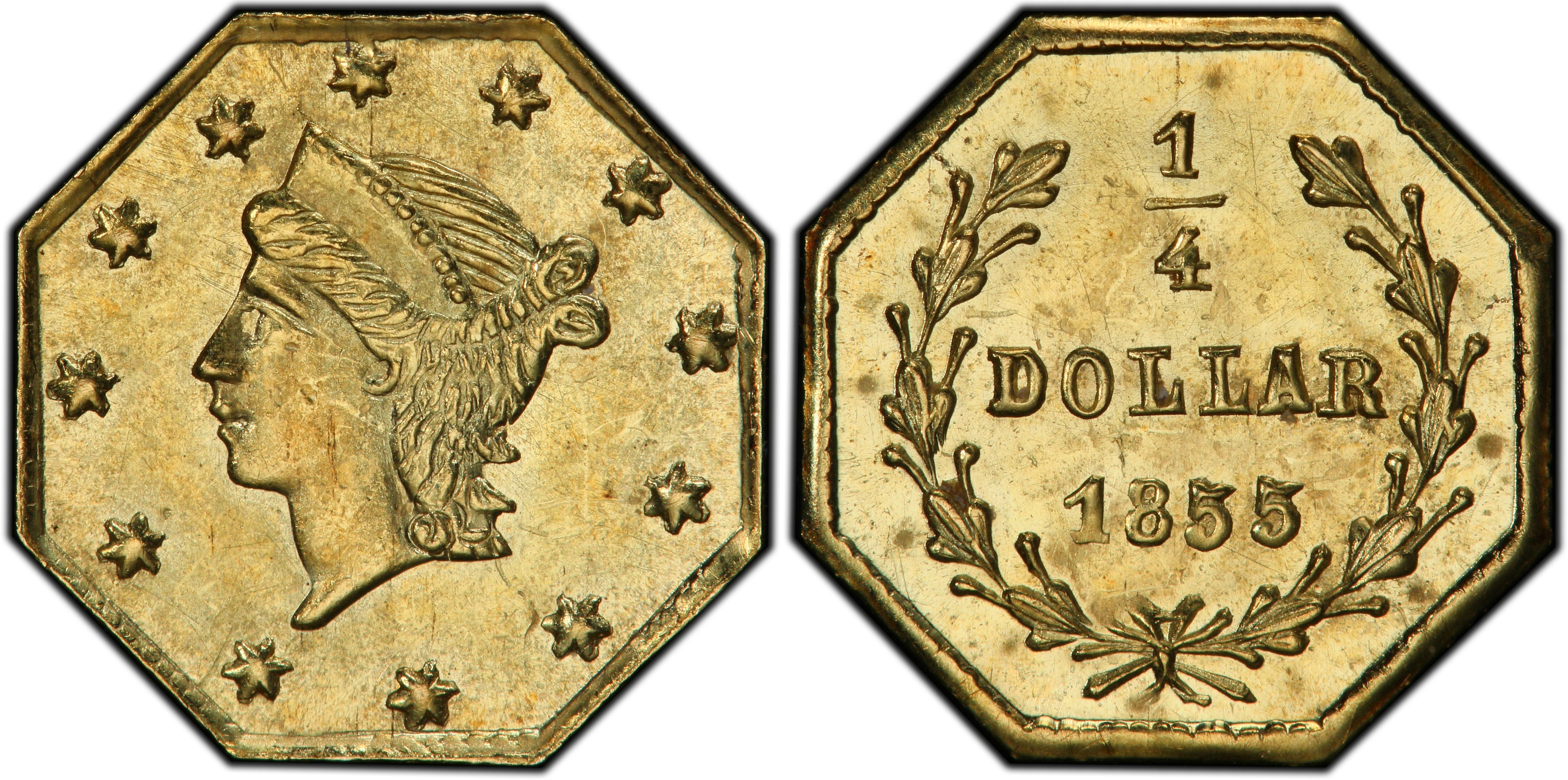
Obverse & Reverse
The 1855 25 Cents, cataloged as Breen-Gillio 110 (BG-110), emerges from the chaotic and vibrant economic landscape of Gold Rush California. In the mid-1850s, San Francisco was the epicenter of a region awash in gold dust but starved for official small-denomination coinage. The United States Mint in San Francisco, which opened in 1854, primarily focused on larger denominations like eagles and double eagles to convert the massive amounts of gold bullion into a fungible form. This left a significant void in the circulating medium for everyday transactions. A cup of coffee, a loaf of bread, or a shave could not be conveniently paid for with a $20 gold piece, and the smallest official coin, the silver three-cent piece, was scarce on the West Coast. This necessity became the mother of invention for numerous jewelers, engravers, and private minters. They stepped in to fill the void by producing their own small-denomination gold coins, now known as California Fractional Gold. These pieces, struck in 25-cent, 50-cent, and one-dollar denominations, were widely accepted in local commerce due to the acute shortage of federal coinage. The BG-110 is attributed to Antoine Louis Nouizillet, a French-born jeweler and watchmaker who arrived in San Francisco in 1852. Like many of his contemporaries, he applied his engraving and metalworking skills to this lucrative enterprise. His work is characterized by a somewhat crude but charming style, indicative of the rudimentary equipment and pressing needs of the time. These privately issued coins circulated freely until the Act of April 22, 1864, which prohibited the private coinage of money, effectively ending this fascinating chapter of American numismatic history. The BG-110 stands as a tangible artifact of a unique period where private enterprise directly addressed a failure in the federal monetary system, creating a diverse and highly collectible series of coinage born from pure necessity.
Associated EventCalifornia Gold Rush
Reason For MintingA severe shortage of circulating small-denomination federal coinage for daily commerce in Gold Rush era California prompted private jewelers to produce their own.
Minter HistoryAntoine Louis Nouizillet was a French immigrant, born circa 1818, who established himself as a jeweler and watchmaker in San Francisco in the early 1850s. His shop was located at 145 Montgomery Street. Capitalizing on the regional currency shortage, he began producing fractional gold coins. His distinctive style, often featuring a somewhat primitive rendering of Liberty and a simple wreath, is identifiable across several known varieties. Though not as prolific as some other private minters like Frontier, Deviercy & Co. or Gaime, Guillemot & Co., Nouizillet's issues are an integral and collectible part of the California Fractional Gold series. He ceased production following the federal prohibition in 1864 and continued his career as a jeweler.
Historical SignificanceThe BG-110, like all California Fractional Gold, represents a critical solution to a regional economic problem and is a testament to the ingenuity and laissez-faire environment of the American West. It highlights a period when the federal government's reach was limited and local economies developed their own unique systems. These pieces are important historical documents of the Gold Rush and the development of California.
N/A
Denomination25 Cents
Minting Period1855
Assayer/MinterAntoine Louis Nouizillet
Geographic OriginSan Francisco, California
Obverse DescriptionThe obverse features a small, somewhat crude bust of Liberty facing left. Her hair is tied in the back with a ribbon. She is surrounded by thirteen stars, which are often weakly struck and may appear as dots or pellets. The stars are typically unevenly spaced.
Obverse Inscription Reverse DescriptionThe reverse design consists of a simple wreath of two branches tied together at the bottom with a bow. The denomination '1/4' is in the center, and the word 'DOLLAR' is positioned below it, just above the bow. The date '1855' is located at the top, between the tips of the wreath branches.
Reverse Inscription1855 1/4 DOLLAR
CompositionGold
Stated Fineness Actual FinenessVaries, but generally around .800 to .900 fine.
Weight0.25 grams
Diameter9.50 mm
EdgePlain
Unknown
Survival Estimate75-125
Rarity ScaleR-5
The BG-110 is sought after for its genuine Gold Rush history, its 'Period One' status (struck before 1856), and its charming, somewhat primitive artistry. It represents one of the earliest and most authentic attempts to solve California's currency crisis. As a tangible link to the Gold Rush, it appeals to both numismatists and historians.
Key VarietiesThe primary variety is the Regular Strike intended for circulation. There are no known major varieties, patterns, or official restrikes for the BG-110. The series of California Fractional Gold is, however, rife with contemporary counterfeits and later-made jeweler's copies or 'souvenir' tokens, particularly those made after the 1880s. These are distinct from the original circulating issues of the 1850s.
Authentication TipsAuthentic BG-110 specimens have a characteristic soft, buttery luster when uncirculated. The strike is often weak in areas, particularly on the stars and the details of the wreath. Look for known die markers and cracks if referencing high-resolution images of certified examples. Counterfeits are numerous and may appear brassy, have incorrect weights, or exhibit tool marks and casting bubbles. The lettering and date style should match known genuine examples; fakes often have poorly formed or incorrectly styled numerals.
Shopping ConsiderationsA premium quality example for this issue is defined by a strong strike, minimal distracting marks, and original surfaces. Look for sharpness on Liberty's portrait and the numbers '1/4' on the reverse. Many examples are weakly struck, so a coin with bold details commands a significant premium. Original, uncleaned surfaces with a hint of reddish-gold toning are highly desirable. Avoid examples that have been harshly cleaned, polished, or mounted in jewelry, as this is common for the series and severely impacts value. Pay close attention to the authenticity; third-party certification by PCGS, NGC, or ANACS is highly recommended for this series.
A coin's grade is its condition, rated on a 1-70 scale. For rare coins, this is the most critical factor in determining value, as a tiny difference in preservation can mean a huge difference in price.
Relevant Grade TypesOriginal period BG-110 issues were business strikes intended for circulation and are found in Circulated (AU-58 and lower) and Mint State (MS-60 to 70) grades. Due to their heavy use, most survivors are in circulated grades. No official Proofs were struck during the original period of issue, nor are there any known later-date restrikes of the BG-110 dies. Any piece described as a 'Proof' would likely be a modern fantasy item or a misattribution of a high-quality business strike with reflective surfaces (Prooflike or PL).
Mint State CharacteristicsAn uncirculated BG-110 will exhibit full, uninterrupted luster, though given the nature of the minter, it is often soft and satiny rather than deeply frosty. The strike is a key variable; a top-tier Mint State example would show unusual sharpness on the stars, Liberty's hair detail, and the leaves of the wreath. Due to the small size and soft gold, even high-grade uncirculated examples can show minor planchet flaws or contact marks from handling with other coins in bags or pouches. The overall eye appeal should be clean and original.
Circulated Wear PatternsWear first appears on the highest points of the design: Liberty's cheek, the hair above her eye, and the ribbon knot in her hair. On the reverse, the high points of the wreath's leaves and the bow will show initial friction and flatness. In lower grades (VF and below), the stars will begin to merge with the field, the date becomes weak, and the central '1/4' will lose its sharp edges. On heavily worn examples, the legends can become faint and difficult to read.
Key Factors For ValueFor the BG-110, the primary value drivers are grade and surface originality. A certified MS-63 example can be worth several times more than an MS-61. The quality of the strike is paramount; a well-struck coin with full details is always prized over a typically weak one of the same grade. Original, uncleaned 'skin' with pleasing eye appeal is critical. Many of these pieces were harshly cleaned over the years, and a coin that has avoided this fate is highly desirable. The presence of a CAC sticker, indicating premium quality for the grade, adds a significant premium for discerning collectors.
PCGS Price Guide
| Grade | Price | Population |
|---|---|---|
| 50 | $225.00 | 1 |
| 50+ | $235.00 | N/A |
| 53 | $260.00 | N/A |
| 53+ | $275.00 | N/A |
| 55 | $300.00 | 3 |
| 55+ | $325.00 | N/A |
| 58 | $350.00 | 12 |
| 58+ | $375.00 | N/A |
| 60 | $400.00 | 4 |
| 61 | $450.00 | 6 |
| 62 | $525.00 | 34 |
| 62+ | $575.00 | N/A |
| 63 | $625.00 | 29 |
| 63+ | $700.00 | N/A |
| 64 | $875.00 | 18 |
| 64+ | $1,050.00 | N/A |
| 65 | $2,000.00 | 1 |
| 65+ | $2,750.00 | N/A |
| 66 | $4,000.00 | N/A |