(1853) G25C BG-221 (Regular Strike)
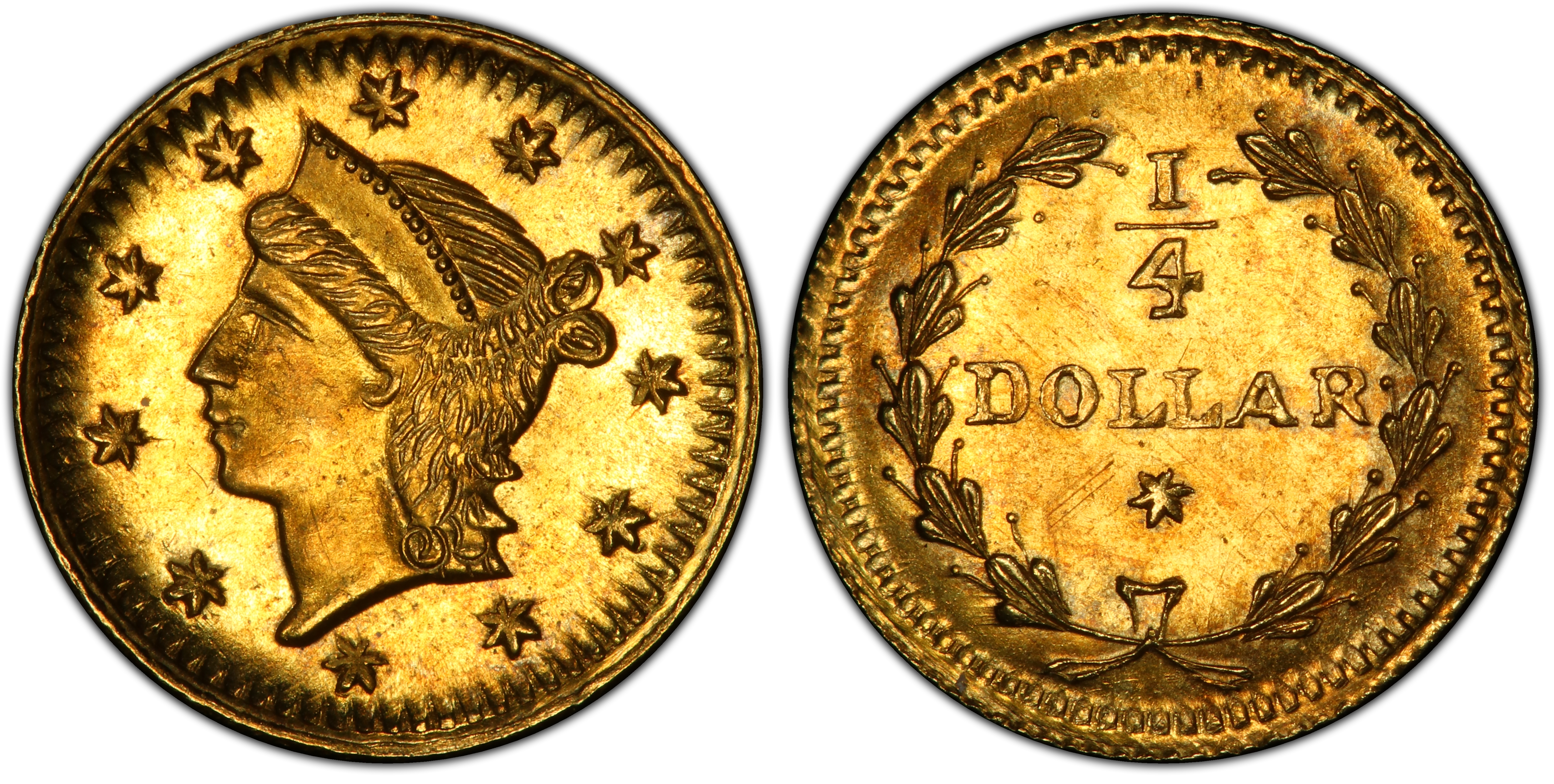
Obverse & Reverse
The 1853 BG-221 quarter dollar is a tangible relic from the chaotic and economically volatile peak of the California Gold Rush. Following the discovery of gold at Sutter's Mill in 1848, a massive influx of over 300,000 'Forty-Niners' descended upon California, transforming it from a remote territory into a burgeoning economic powerhouse. This explosive growth created an acute crisis in commerce: a dire shortage of circulating small-denomination coinage. With the nearest U.S. Mint in New Orleans, transactions were often conducted with cumbersome pinches of gold dust, a notoriously inaccurate and inefficient method. While several private firms began issuing larger denomination coins ($5 to $50), the need for 'pocket change' for everyday purchases remained unmet. Into this void stepped enterprising jewelers and metallurgists in San Francisco. From 1852 to 1857, a period numismatists classify as 'Period One,' these craftsmen produced fractional gold coins in 25-cent, 50-cent, and dollar denominations. The BG-221 is a quintessential example of these early, utilitarian issues. Unlike later 'Period Two' and 'Period Three' pieces, which were often underweight and made primarily as souvenirs, Period One coins like the BG-221 were struck with a high gold content and were genuinely intended to, and did, circulate to facilitate local trade. They were produced by hand, using a hammer-striking method that resulted in coins of varying strike quality. Public acceptance was mixed; while they filled a crucial need, their small size made them easy to lose. By 1854, the establishment of the San Francisco Mint began to resolve the coin shortage, and the circulation of these private fractionals waned. Most were eventually melted, contributing to their present-day scarcity. The BG-221 thus represents a critical, short-lived solution to an economic problem, embodying the ingenuity and entrepreneurial spirit that defined the Gold Rush era.
Associated EventCalifornia Gold Rush
Reason For MintingTo alleviate a severe shortage of small-denomination coinage for daily commercial transactions in Gold Rush-era California.
Minter HistoryAntoine Louis Nouizillet was one of several French jewelers who became private minters in San Francisco during the Gold Rush. These craftsmen applied their existing skills in metallurgy and die-cutting to meet the region's desperate need for coinage. Like many of his contemporaries, Nouizillet's operation was a small-scale, private enterprise, and he is credited with producing several distinct varieties of fractional gold. His work is characteristic of the Period One issues, which are noted for their relatively high quality and gold content compared to later souvenir pieces.
Historical SignificanceAs a 'Period One' issue, the BG-221 is historically significant for being a genuine circulating medium of exchange during the height of the Gold Rush, not merely a souvenir. It represents a private, entrepreneurial solution to a government failure in providing adequate coinage for a rapidly growing economy, making it a key artifact of American monetary and frontier history.
BG-221
Denomination$0.25
Minting Period1853
Assayer/MinterAntoine Louis Nouizillet
Geographic OriginSan Francisco, California
Obverse DescriptionA right-facing Liberty Head, stylistically similar to the contemporary U.S. Gold Dollar, surrounded by a circle of eleven six-pointed stars.
Obverse Inscription Reverse DescriptionThe denomination '25 CENTS' is displayed in two lines, positioned above a prominent six-pointed star. The entire central device is enclosed within a simple beaded circle or wreath.
Reverse Inscription25 CENTS
CompositionGold (alloyed with native silver)
Stated FinenessNot stated on the coin.
Actual FinenessPeriod One issues are known to have high gold content, often from native California gold which contained a natural alloy of silver, giving them a slightly lighter color. Fineness is generally considered to be between 14 and 22 carats.
Weight0.90 grams
Diameter11.00 mm
EdgePlain
Unknown
Survival EstimateApproximately 201-500 known examples.
Rarity ScaleR-3
This variety is highly sought after as a historically important 'Period One' issue, struck for actual commerce during the Gold Rush. Its classic Liberty Head design, clear denomination, and connection to a known San Francisco jeweler make it a cornerstone piece for collectors of Territorial gold and Gold Rush memorabilia.
Key VarietiesThe primary variety is BG-221 itself. Within the broader series, collectors distinguish between Period One (1852-1857, for circulation), Period Two (1858-1882, souvenirs), and Period Three (post-1883, clandestine back-dated issues). The BG-221 is a quintessential Period One business strike. There are no known patterns, trial pieces, or later-date Proof restrikes associated specifically with the BG-221 variety.
Authentication TipsGenuine BG-221 specimens should be compared to high-resolution images in the Breen-Gillio reference or from major grading services. Due to the hammer-striking process, genuine pieces are often imperfectly struck; a perfectly struck, perfectly round coin with sharp, modern-looking denticles should be viewed with suspicion. Many crude counterfeits exist, often with incorrect design details, weight, or a soapy, cast-like appearance. Be wary of any pieces featuring a bear, as no genuine fractional gold from this period used that motif. Professional authentication by PCGS or NGC is highly recommended.
Shopping ConsiderationsA premium quality example for its grade will exhibit a bold strike for the issue, particularly on the high points of Liberty's hair and the stars on the obverse, and the denomination on the reverse. Seek out coins with minimal distracting marks and original, uncleaned surfaces, which may show a soft, satiny luster and attractive reddish or greenish-gold toning from the native gold alloy. Due to their small size, these coins are prone to being bent, holed, or used in jewelry; inspect carefully for evidence of mounting, tooling, or repairs, especially around the rim. A coin with a CAC sticker indicates superior quality for the grade and often commands a significant premium.
A coin's grade is its condition, rated on a 1-70 scale. For rare coins, this is the most critical factor in determining value, as a tiny difference in preservation can mean a huge difference in price.
Relevant Grade TypesAll original BG-221 coins are business strikes intended for circulation and are found in Circulated (1-58) and Mint State (MS, 60-70) grades. No Proofs were struck during the original minting period, nor are there any known later-date collector Proof restrikes of this specific variety. Any piece described as a 'Proof' would be highly suspect.
Mint State CharacteristicsAn uncirculated BG-221 typically displays a soft, somewhat satiny luster characteristic of the high-purity, soft gold used. The strike is a key differentiator; many are weakly struck in the centers or on peripheral devices like the stars. A well-struck Mint State example with full detail on Liberty's hair and the reverse star is rare and highly desirable. Small planchet flaws or adjustment marks are not uncommon given the primitive minting process.
Circulated Wear PatternsWear first appears on the highest points of the design: Liberty's cheek, the hair above her eye and ear, and the coronet. On the reverse, the high points of the letters in 'CENTS' and the central star will show initial friction and flattening. In lower grades (VG and below), the stars on the obverse will begin to merge with the field, and the reverse legends will become faint.
Key Factors For ValueThe primary value drivers for a BG-221 are grade and surface preservation. An example with original, uncleaned 'skin' is far more valuable than a cleaned or polished coin of the same grade. Strike quality is paramount; a sharply struck coin can command a significant premium over a weakly struck example in the same numerical grade. Eye appeal, including attractive original toning and a lack of distracting marks, is also critical. Finally, certification by a top-tier service (PCGS or NGC) is nearly essential for market acceptance and liquidity, with a CAC sticker adding a further premium for exceptional quality.
PCGS Price Guide
| Grade | Price | Population |
|---|---|---|
| 50 | $210.00 | N/A |
| 50+ | $225.00 | N/A |
| 53 | $240.00 | N/A |
| 53+ | $255.00 | N/A |
| 55 | $275.00 | 9 |
| 55+ | $300.00 | N/A |
| 58 | $325.00 | 11 |
| 58+ | $345.00 | N/A |
| 60 | $365.00 | 4 |
| 61 | $400.00 | 19 |
| 62 | $425.00 | 63 |
| 62+ | $450.00 | N/A |
| 63 | $475.00 | 63 |
| 63+ | $525.00 | N/A |
| 64 | $600.00 | 45 |
| 64+ | $750.00 | 1 |
| 65 | $1,250.00 | 2 |
| 65+ | $1,500.00 | N/A |
| 66 | $2,000.00 | 1 |