1867 G25C BG-709 (Regular Strike)
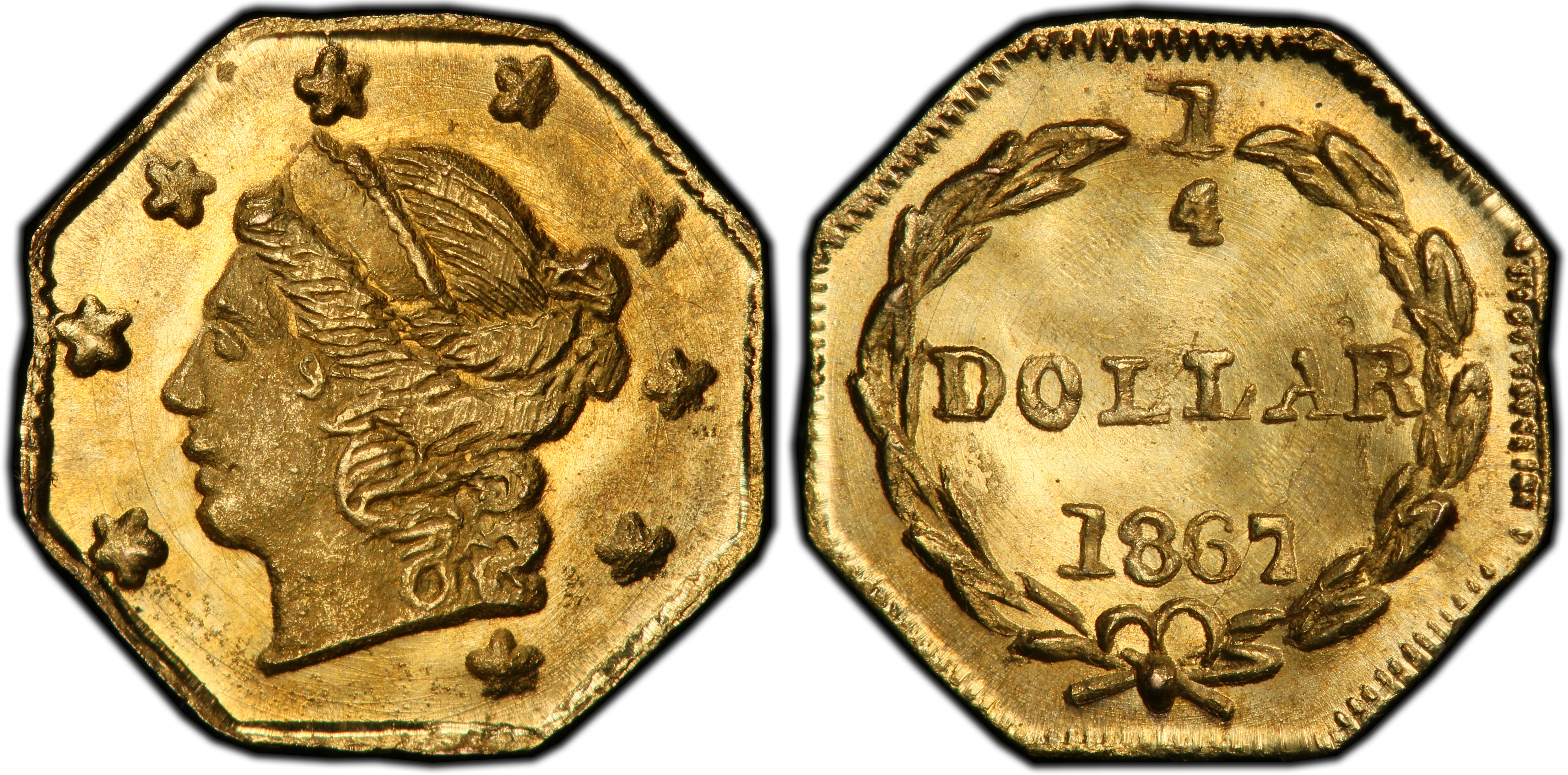
Obverse & Reverse
The 1867 G25C BG-709 is a quintessential example of a 'Period Two' California Fractional Gold piece, a fascinating and complex series born from the economic realities of the American West. The initial gold rush (1849-1856) created a severe shortage of small-denomination coinage, leading private minters to strike 'Period One' fractional gold to facilitate daily commerce. These early issues were generally of good quality and intended for circulation. By the late 1850s, the San Francisco Mint was in full operation, alleviating the coin shortage. However, a new market had emerged. Jewelers and entrepreneurs realized the potentional of these miniature gold coins as souvenirs and keepsakes for tourists, Easterners, and Europeans captivated by the romance of the Gold Rush. This gave rise to the 'Period Two' issues (1859-1882), to which the BG-709 belongs. Unlike their predecessors, these coins were not primarily intended for circulation. They were 'jeweler's issues,' often underweight and struck from debased gold, with their intrinsic value being significantly less than their face value. The Coinage Act of 1864 technically outlawed private coinage, but enforcement on the remote West Coast was lax until the early 1880s, allowing these pieces to be openly produced and sold. The minters of Period Two issues are largely anonymous, operating small-scale operations and often using crude, hand-operated presses. The variety of designs proliferated during this era, with the BG-709 featuring a classic Liberty Head motif. The very existence of this coin speaks to a transitional period in California's economy, moving from a frontier society of necessity to a more established region with a burgeoning tourism trade. These pieces were collected from the moment they were made, which accounts for the relatively high proportion of survivors in Mint State condition, though many also fell victim to being mounted in jewelry.
Associated EventPost-Gold Rush California Economy
Reason For MintingPrimarily struck for sale as souvenirs and jewelry items to tourists and collectors, rather than to alleviate a coin shortage.
Minter HistoryThe specific minter or jewel-smith responsible for the BG-709 variety is unknown, a common trait for Period Two fractional gold pieces. Production was decentralized among various San Francisco jewelers who created their own proprietary dies. They operated in a legally grey area after the Coinage Act of 1864, and anonymity was likely a prudent business practice. These artisans were skilled in working with gold but were not official government minters, resulting in products of varying quality and metallic content.
Historical SignificanceThe BG-709 is historically significant not as a coin of circulation, but as a memento of the California Gold Rush mythos. It represents the commercialization of the Gold Rush legend and the beginning of California's tourism industry. Numismatically, it is an important part of the vast and intricate series of California Fractional Gold, which as a whole tells the story of the evolution of commerce and private enterprise on the American frontier.
K-N/A
Denomination25 Cents
Minting Period1867
Assayer/MinterUnknown Private Minter
Geographic OriginSan Francisco, California
Obverse DescriptionA beaded border encircles a right-facing head of Liberty. Liberty wears a coronet, and her hair is tied in the back. Thirteen stars surround the portrait, representing the original colonies.
Obverse Inscription[NONE]
Reverse DescriptionA decorative wreath of leaves and berries, tied at the bottom with a bow, encircles the denomination. The design is characteristic of Period Two issues, often featuring fuller wreaths compared to Period One coins.
Reverse Inscription1/4 DOLLAR 1867
CompositionGold
Stated Fineness Actual FinenessVariable, often debased. Period Two issues are typically found in the 14 to 22 karat range.
Diameter9.40 mm
EdgePlain
Unknown, but very small.
Survival Estimate75-150 known specimens. Population reports from PCGS and NGC show a combined total of over 70 graded examples, suggesting a surviving population in this range.
Rarity ScaleR-4 (76-200 Known) to R-5 (31-75 Known)
This coin is sought after for its historical connection to the Gold Rush era, its charming miniature design, and its status as a tangible artifact of 19th-century private minting. The octagonal shape is a classic feature of pioneer gold that adds to its appeal. As a dated and denominated Period Two piece, it occupies a sweet spot for collectors building type sets of this popular series.
Key VarietiesNo major, widely recognized varieties of BG-709 are cataloged. The primary variations among surviving examples relate to strike quality, planchet quality (some show striations or file marks from preparation), and minor die states. There are no known official restrikes or patterns associated with this specific variety.
Authentication TipsAuthentic Period Two pieces must be denominated (e.g., 'DOLLAR' or 'CENTS'). Be wary of modern replicas which often say 'CALIFORNIA GOLD' but lack a monetary value. Genuine BG-709s have a specific die look; compare any potential purchase to high-resolution images from major grading services. Counterfeits are often soapy in appearance, lacking the sharp detail of genuine strikes. Look for characteristic die markers if known, and be suspicious of incorrect weight, diameter, or metallic properties (many fakes are brass or gilt).
Shopping ConsiderationsA premium quality example for its grade will exhibit a sharp, well-centered strike, particularly on Liberty's hair and the leaves of the wreath. Luster is a key value driver; look for coins with original, satiny fields. Prooflike (PL) or semi-PL surfaces command a significant premium. Common issues to avoid include cleaning, which dulls the luster and imparts hairline scratches, and evidence of being mounted in jewelry, such as solder marks or rim damage. Original, un-cleaned surfaces with attractive deep yellow or reddish-gold toning are highly desirable.
A coin's grade is its condition, rated on a 1-70 scale. For rare coins, this is the most critical factor in determining value, as a tiny difference in preservation can mean a huge difference in price.
Relevant Grade TypesOriginal issues were business strikes, although not intended for widespread circulation. They are found in all Circulated grades (AG-3 to AU-58) and, more commonly for this souvenir issue, in Mint State (MS-60 to MS-70). No true Proofs were struck during the original period of issue. Any piece described as a 'Proof' would be a later-date issue or a misattribution of a business strike with prooflike surfaces.
Mint State CharacteristicsUncirculated examples of BG-709 are defined by their luster, which is typically soft and satiny, though some possess reflective, prooflike fields. Strike quality varies; many were not struck with full force. A well-struck example will show full detail in Liberty's coronet and hair strands, and sharp definition on the wreath's leaves and bow. Due to the softness of the gold and the manufacturing process, it is common to see minor planchet striations or faint adjustment marks under the luster; these are often considered acceptable and part of the coin's character.
Circulated Wear PatternsWear first appears on the highest points of the design. On the obverse, friction will first flatten the hair above Liberty's eye and ear, and the highest points of the coronet. On the reverse, the high points of the wreath leaves and the loops of the bow will show initial wear. In lower grades (VF and below), the stars and lettering will begin to soften and merge with the fields.
Key Factors For ValueFor the BG-709, the primary value drivers are grade and surface quality. An example with original, undisturbed luster will always be worth more than a cleaned or polished coin of the same grade. Strike sharpness is critical; a fully struck gem is far more desirable than a weakly struck piece. Eye appeal, encompassing attractive toning and a lack of distracting marks or planchet flaws, plays a major role. A sticker from CAC (Certified Acceptance Corporation) indicating a premium quality coin for its assigned grade will add a significant premium.
PCGS Price Guide
| Grade | Price | Population |
|---|---|---|
| 55 | $230.00 | 1 |
| 55+ | $235.00 | N/A |
| 58 | $240.00 | 1 |
| 58+ | $245.00 | N/A |
| 60 | $250.00 | N/A |
| 61 | $270.00 | 1 |
| 62 | $300.00 | 6 |
| 62+ | $320.00 | N/A |
| 63 | $400.00 | 11 |
| 63+ | $425.00 | N/A |
| 64 | $475.00 | 22 |
| 64+ | $535.00 | N/A |
| 65 | $950.00 | 25 |
| 65+ | $1,000.00 | 1 |
| 66 | $1,400.00 | 16 |
| 66+ | $1,750.00 | N/A |
| 67 | $3,250.00 | 4 |
| 67+ | $3,750.00 | 1 |
| 68 | $4,500.00 | N/A |