1859 G25C BG-703 (Regular Strike)
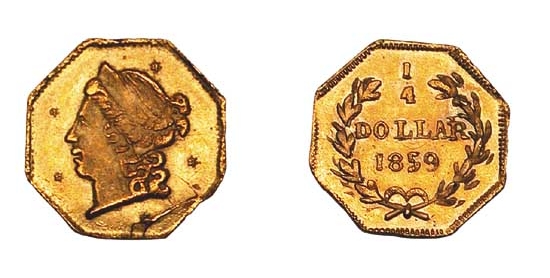
Obverse & Reverse
The 1859 G25C BG-703 is a product of the second phase of California's fractional gold production, a fascinating and complex chapter in American numismatics. The initial 'Period One' (1852-1857) pieces were born of a genuine economic necessity. The massive influx of population during the Gold Rush created a severe shortage of small-denomination coinage for daily transactions, a void that private jewelers and smiths rushed to fill with minuscule gold quarters, halves, and dollars. These early issues, though unofficial and often underweight, served a vital commercial purpose. However, by 1859, the landscape had changed. The San Francisco Mint was in full operation, producing ample federal coinage and alleviating the initial shortage. The impetus for creating fractional gold shifted from commerce to collectivism and souvenirs. The 'Period Two' issues (1859-1882), to which the BG-703 belongs, were struck primarily as keepsakes and jewelry items for tourists and locals nostalgic for the Gold Rush heyday. These pieces were not intended to, and largely did not, circulate as money. Their designs became more varied and less imitative of federal coinage, and their gold content was often lower and less consistent than the earlier issues. The Coinage Act of 1864 officially prohibited private coinage, but enforcement was lax, allowing jewelers to continue producing these popular tokens for nearly two more decades. The BG-703, dated 1859, marks the very beginning of this transition, representing a tangible link between the utilitarian origins of fractional gold and its later life as a cherished memento of California's defining era.
Associated EventPost-Gold Rush California Economy / Rise of Souvenir Coinage
Reason For MintingPrimarily created for sale as a souvenir or jewelry item for tourists and collectors, not for general circulation.
Minter HistoryThe specific minter of the BG-703 variety is unknown, a common trait for many 'Period Two' California Fractional Gold pieces. Following the establishment of the San Francisco Mint, the production of these small-denomination gold pieces shifted from a semi-official necessity to a more clandestine, profit-driven enterprise by various jewelers in San Francisco and other cities. These makers often did not sign their work to avoid scrutiny from federal authorities, leaving a legacy of fascinating but anonymous issues.
Historical SignificanceThe BG-703 is historically significant as an exemplar of 'Period Two' fractional gold. It represents the commercial evolution of private coinage from a necessary medium of exchange to a souvenir commodity, reflecting California's own transition from a raw frontier to a place of myth and tourism. Its existence demonstrates the continued popular fascination with gold and the Gold Rush, even after the initial economic need for such pieces had subsided.
N/A
Denomination25 Cents
Minting Period1859
Assayer/MinterUnknown Jeweler
Geographic OriginSan Francisco, California (presumed)
Obverse DescriptionA beaded border encloses a Liberty Head facing left, similar in style to the U.S. gold dollar, but often of cruder execution. Thirteen stars encircle the head.
Obverse Inscription[No Inscription]
Reverse DescriptionAn octagonal beaded border surrounds a wreath of two olive branches tied with a bow at the bottom. The denomination '25 CENTS' is in the center, with the date '1859' below the wreath and above the bow.
Reverse Inscription25 CENTS 1859
CompositionGold
Stated Fineness Actual FinenessVariable, often lower than federal standards, typical for Period Two issues.
Weight0.25 grams
Diameter9.00 mm
EdgePlain
Unknown
Survival EstimateFewer than 10
Rarity ScaleR-7 (4 to 12 known)
The BG-703 appeals to specialists in California gold due to its extreme rarity and its status as a 'Period Two' issue. Its octagonal shape and classic Liberty Head design are aesthetically pleasing, and its scarcity provides a significant challenge for advanced collectors attempting to complete a set of BG-numbered varieties.
Key VarietiesThis is a single, specific die marriage (BG-703) from the original minting period. There are no known official restrikes, patterns, or trial pieces associated with this variety. Collectors should be aware of a closely related variety, BG-703A, which is dated 1856.
Authentication TipsAuthentic examples will exhibit sharp, albeit sometimes crude, die characteristics consistent with hammer striking. The surfaces should have the texture of genuine gold, not the porous or soapy feel of cast counterfeits or the uniform sheen of modern gold plating. The numerals in the date and the letters in 'CENTS' should match known genuine examples precisely. Any piece with a bear on the reverse is a modern replica. Due to its high rarity, any prospective purchase should be certified by a major third-party grading service (PCGS or NGC).
Shopping ConsiderationsFor a coin of this rarity, any example is a significant find. A premium quality specimen would be one that is well-centered and sharply struck for the issue, particularly on the stars and the details of the wreath. Look for original, uncleaned surfaces with a hint of reddish-gold toning. Many fractional gold pieces were used as jewelry, so check carefully for evidence of mounting, solder, or tooling, especially around the rim. Given the population of just a few known pieces, even a problem-free circulated example would be a major prize. The vast majority of surviving examples are in Mint State, as they were sold as souvenirs and not used in commerce.
A coin's grade is its condition, rated on a 1-70 scale. For rare coins, this is the most critical factor in determining value, as a tiny difference in preservation can mean a huge difference in price.
Relevant Grade TypesOriginal period issues were business strikes intended for sale to collectors and tourists, not for circulation. Therefore, they are found in both Circulated (1-58) and, more commonly, Mint State (MS, 60-70) grades. No Proof (PR/PF) examples of this variety were struck during the original period of issue, and no later-date Proof restrikes are known to exist.
Mint State CharacteristicsUncirculated examples of BG-703 often exhibit a soft, satiny luster. The strike can be inconsistent due to the primitive hammer-striking process, with some weakness possible on the highest points of Liberty's hair and the leaves of the wreath. Small planchet flaws or adjustment marks are not uncommon and should be assessed for their impact on eye appeal. Contact marks, even on high-grade pieces, are to be expected due to the softness of the gold and the way these small pieces were handled in bulk.
Circulated Wear PatternsAlthough rarely seen with circulation, wear would first appear on the high points of Liberty's hair, cheek, and the coronet. On the reverse, the highest points of the wreath leaves and the numerals of the denomination would show the first signs of friction. In lower grades (e.g., VF or below), the stars on the obverse would begin to merge with the fields.
Key Factors For ValueRarity is the paramount factor for BG-703; with only a handful of examples known, any certified, problem-free coin is extremely valuable. Surface preservation is critical; an example with original, lustrous 'skin' is far more desirable than one that has been cleaned, polished, or shows evidence of jewelry use. Strike quality is also important, with collectors paying a premium for sharply detailed examples. Finally, given the tiny population, a CAC sticker signifying premium quality for the grade would add a very significant premium.
PCGS Price Guide
| Grade | Price | Population |
|---|---|---|
| 63 | $30,000.00 | 1 |