1866 25C BG-737 (Regular Strike)
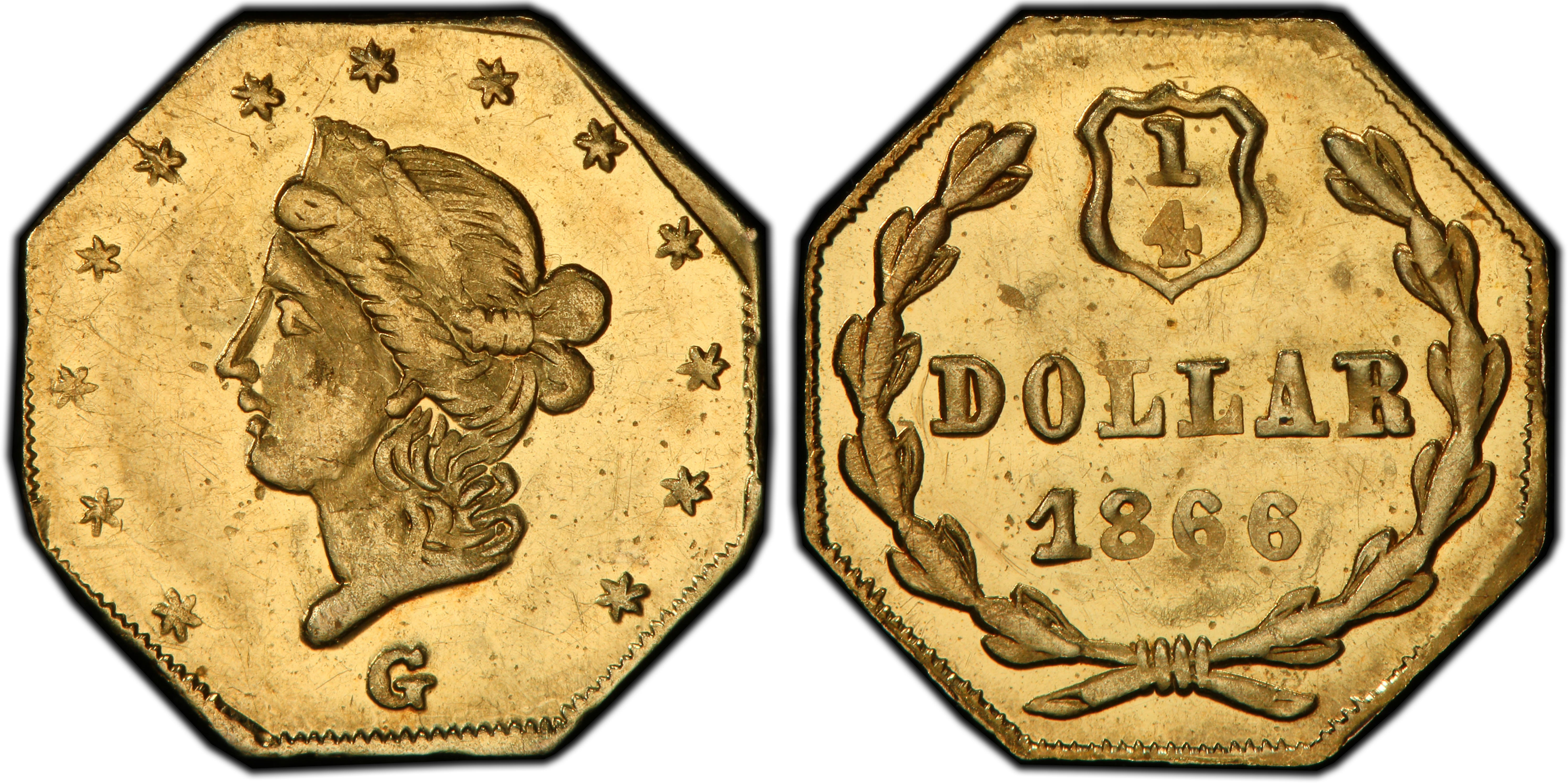
Obverse & Reverse
The 1866 25 Cents, cataloged as Breen-Gillio 737, is a quintessential example of a 'Period Two' California Fractional Gold piece. By the mid-1860s, the initial, desperate need for small denomination coinage that fueled the creation of the earlier 'Period One' issues (1852-1857) had largely subsided. The San Francisco Mint was in full operation, producing ample federal silver and gold coins for commerce. However, the allure of the Gold Rush and the romance of private gold coinage had created a new market: souvenirs and keepsakes. San Francisco jewelers, leveraging their metallurgical skills, stepped in to fill this demand. These 'jeweler's issues' were not intended to circulate as money in the same way as their predecessors, but were instead sold as charms, mementos for tourists, or novelties for those back East captivated by tales of California gold. The year 1866 is particularly significant as it falls two years after the Coinage Act of 1864, which explicitly made the private minting of coinage illegal. Despite this federal law, enforcement by the Secret Service was inconsistent and not fully realized in California until the 1880s. This legal gray area allowed for the continued production of denominated pieces like the BG-737. Stylistically, BG-737 is often associated with the workshop of Robert B. Gray & Co., a prolific producer of fractional gold during this era. Gray had purchased the business of another jeweler, Antoine Nouizillet, around 1859-60 and continued producing pieces with both old and new dies. While this specific variety lacks the characteristic 'G' mintmark found on many of Gray's other issues, the overall fabric, die work, and quality are consistent with his known output. These pieces were typically struck with manually operated presses, often leading to variations in strike quality. The use of dies beyond their optimal lifespan was common, resulting in issues struck from rusted or deteriorating dies, a known characteristic of the BG-737 variety. Their intrinsic value was often less than their face value, a defining feature of Period Two issues, confirming their status as commercial novelties rather than true coinage meant to pass at par in daily transactions.
Associated EventCalifornia Gold Rush (Post-Rush Souvenir Period)
Reason For MintingPrimarily created as a souvenir or keepsake for the tourist trade, capitalizing on the romanticism of the Gold Rush, rather than to alleviate a currency shortage.
Minter HistoryWhile not definitively signed, BG-737 is attributed to the circle of San Francisco jewelers active in the 1860s, with strong stylistic links to Robert B. Gray & Co. Gray was a prominent jeweler who became a major force in the fractional gold market after acquiring the dies and equipment of Antoine Nouizillet. Gray's firm produced a wide variety of denominated gold pieces from the late 1850s until 1871, often marking his coins with a distinct 'G'. His issues are noted for being of generally higher weight and quality compared to some other Period Two producers, though like all makers of the era, die rust and inconsistent strike quality are known characteristics of his firm's output.
Historical SignificanceThe BG-737 represents a transitional phase in private coinage, moving from a utilitarian response to a coin shortage to a commercial enterprise producing numismatic souvenirs. Its existence, minted after the 1864 prohibition on private coinage, highlights the unique economic and legal conditions of post-Civil War California and the persistent legacy of the Gold Rush in popular culture.
BG-737
Denomination25 Cents
Minting Period1866
Assayer/MinterUnknown, attributed stylistically to Robert B. Gray & Co.
Geographic OriginSan Francisco, California
Obverse DescriptionA fairly crude rendering of a Liberty Head facing left, her hair tied in a bun. The portrait is surrounded by thirteen five-pointed stars, often weakly defined. The date '1866' appears below the bust.
Obverse Inscription1866
Reverse DescriptionThe denomination '25 CENTS' is displayed within a simple wreath composed of two branches tied with a bow at the bottom. The wreath is typically open at the top.
Reverse Inscription25 CENTS
CompositionGold
Stated Fineness Actual FinenessVariable, but typical for Period Two issues (often 14-21 Karat).
Weight0.25 grams
Diameter9.50 mm
EdgePlain
Unknown
Survival EstimateFewer than 12
Rarity ScaleR-7
As an R-7 variety, the BG-737 is highly sought after by specialists in the California Fractional Gold series for its extreme rarity. Its appeal lies in its connection to the post-Gold Rush era, representing one of the many privately produced 'jeweler's issues' that continued despite federal prohibition.
Key VarietiesThe primary variety is the regular business strike. A Prooflike (PL) designated variety is also recognized by PCGS, representing examples struck from freshly polished dies that exhibit mirrored fields. No known restrikes or official patterns exist for this specific variety.
Authentication TipsGenuine examples often exhibit a distinctive light 'pebbled' or granular surface texture, a result of the planchet being struck by a rusted obverse die. The strike is characteristically soft, particularly on the stars and the details of the wreath. The numerals in the date and the letters in 'CENTS' can be crude and unevenly spaced. Be wary of modern replicas which often have a soapy, cast-like appearance, sharp wire rims, or a design that is too perfect and well-struck. Many fakes are also gold-plated base metal and will be incorrect in weight. Authentic pieces have a dull, original luster, not the bright, brassy shine of many copies.
Shopping ConsiderationsFor a 'premium quality' example, a buyer should seek a piece that, despite the inherent striking weaknesses, shows as much detail as possible on Liberty's hair and the wreath. An example with minimal abrasions and a lack of significant planchet flaws (voids or rust pits, though some are common) is desirable. Original, uncleaned surfaces with a pleasant rose-gold or lemon-gold patina command a significant premium. Avoid examples that have been harshly cleaned, polished, or mounted in jewelry, as this is common for these souvenir-type pieces and severely impacts value. Given the rarity, even a problem-free circulated example in AU condition is a significant prize.
A coin's grade is its condition, rated on a 1-70 scale. For rare coins, this is the most critical factor in determining value, as a tiny difference in preservation can mean a huge difference in price.
Relevant Grade TypesOriginal period issues were business strikes, technically intended for sale rather than circulation, and are found in both Circulated (1-58) and Mint State (MS, 60-70) grades. Due to their nature as souvenirs, high-grade examples are more common than for Period One issues. No true Proofs were struck during the original period. The Prooflike (PL) designation is sometimes applied to business strikes made with polished dies, but these are not a separate issue.
Mint State CharacteristicsUncirculated examples of BG-737 are defined by the presence of original mint luster, which is typically soft and satiny. A key diagnostic for this issue is the obverse surface, which is often lightly pebbled or granular due to being struck with a rusted die; this is considered 'as made' and not a defect. The strike is almost always weak on the wreath and the stars. A top-tier MS example would show better-than-average definition on these elements and clean, mark-free fields.
Circulated Wear PatternsWear first appears on the highest points of the design: Liberty's cheek, the hair above her ear, and the highest leaves and bow of the wreath. On moderately circulated examples, the stars will begin to lose their definition and merge with the fields. In lower grades (Fine and below), the date and the legend '25 CENTS' will become faint and difficult to read.
Key Factors For ValueFor the BG-737, rarity is the primary driver of value. Beyond that, the most significant factors are surface preservation and strike. An example with original, undisturbed surfaces and attractive toning will always be prized over a cleaned or damaged coin. While a weak strike is typical, any specimen showing unusual sharpness, particularly on the wreath, will command a substantial premium. Eye appeal is critical; a coin with a pleasing appearance, even with known die rust artifacts, is highly desirable. A CAC sticker for this issue would be a strong endorsement of its quality for the grade.
PCGS Price Guide
| Grade | Price | Population |
|---|---|---|
| 53 | $275.00 | 1 |
| 53+ | $280.00 | N/A |
| 55 | $300.00 | 1 |
| 55+ | $305.00 | N/A |
| 58 | $325.00 | 1 |
| 58+ | $345.00 | N/A |
| 60 | $425.00 | 2 |
| 61 | $475.00 | 5 |
| 62 | $550.00 | 6 |
| 62+ | $675.00 | N/A |
| 63 | $925.00 | 11 |
| 63+ | $1,600.00 | N/A |
| 64 | $3,250.00 | 3 |
| 64+ | $4,000.00 | N/A |