1853 G50C BG-414 (Regular Strike)
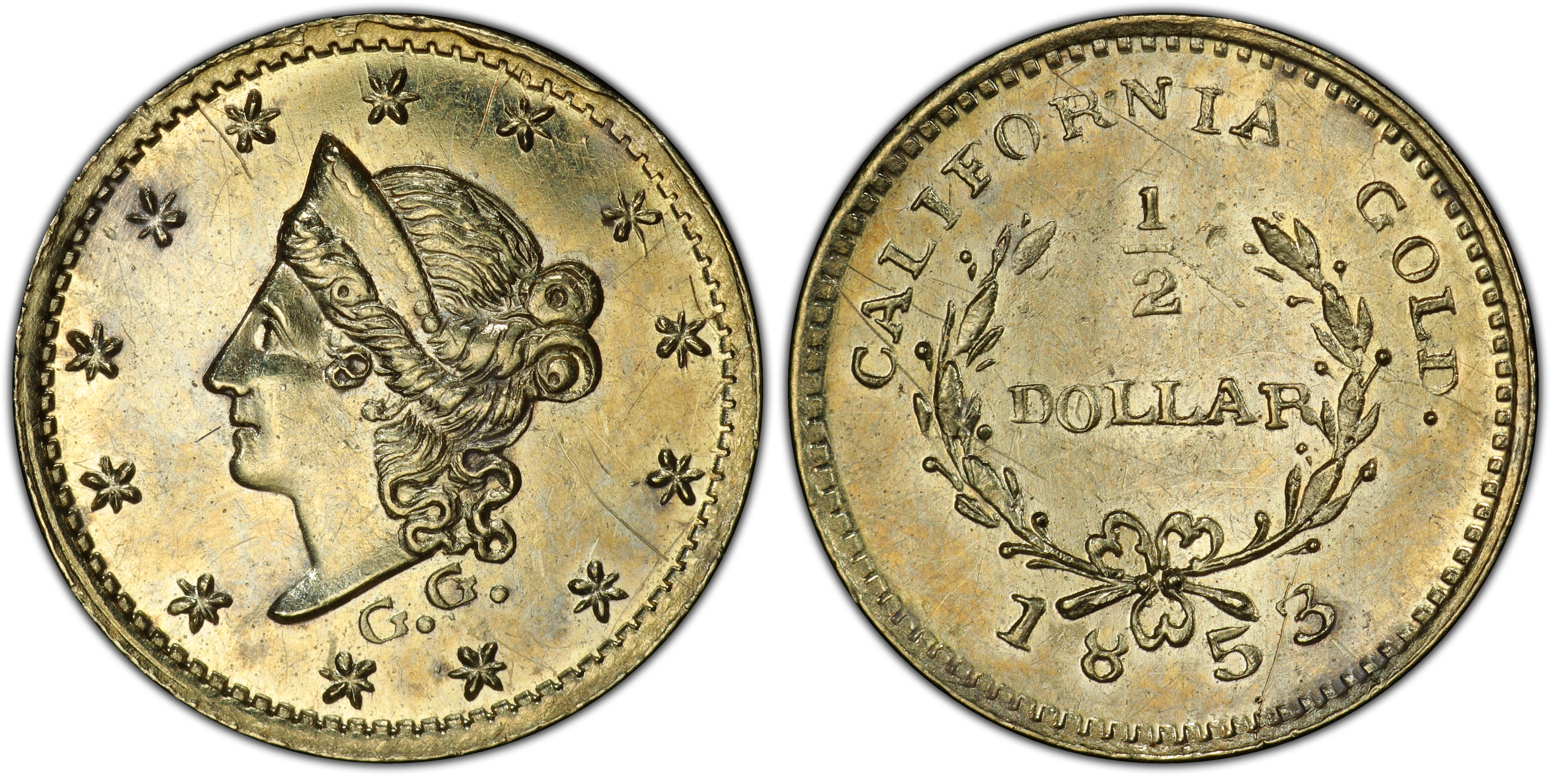
Obverse & Reverse
The 1853 Gold 50 Cents, cataloged as Breen-Gillio 414, is a quintessential artifact from the chaotic and economically vibrant era of the California Gold Rush. Following the discovery of gold at Sutter's Mill in 1848, a massive influx of prospectors and merchants descended upon California, creating a booming economy almost overnight. However, this rapid growth far outpaced the supply of official United States coinage, leading to a severe shortage of small change for daily transactions. While gold dust and nuggets served for larger purchases, the need for fractional currency to buy a meal, a drink, or basic supplies was acute. In response to this commercial crisis, private jewelers and metallurgists in San Francisco began striking their own small-denomination gold coins in 1852. The BG-414 is a 'Period One' issue, a designation given to coins struck between 1852 and 1857 that were genuinely intended to circulate and alleviate the coin shortage. Unlike the later, often underweight 'Period Two' souvenir pieces, these early issues were generally accepted in local commerce. The production method for these tiny coins was rudimentary, typically involving hand-cut dies and a hammer strike, which resulted in significant variation between specimens. The anonymous minter of BG-414 likely operated a small, efficient establishment, producing coins that mimicked the general appearance of federal gold coinage to inspire public trust. These fractional pieces, however, were almost universally underweight, providing a tidy profit for their makers. The BG-414, like its contemporaries, filled a vital monetary niche until the San Francisco Mint began full-scale production of federal coinage in the mid-1850s, gradually rendering the private issues obsolete. Today, the BG-414 is a tangible link to the rugged, entrepreneurial spirit of Gold Rush California, representing a private solution to a public economic problem.
Associated EventCalifornia Gold Rush
Reason For MintingTo alleviate a severe shortage of small-denomination coinage for everyday commercial transactions in Gold Rush-era California.
Minter HistoryThe specific assayer or jeweler who produced the BG-414 variety is unknown. During 'Period One' (1852-1857), numerous San Francisco jewelers, many of French origin, such as Antoine Louis Nouizillet and the firm of Frontier & Deviercy, produced fractional gold. The BG-414 is a 'maverick' issue, lacking any identifying initials or marks that would allow for a definitive attribution to a known minter.
Historical SignificanceAs a 'Period One' issue, this coin is a genuine circulating medium from the height of the California Gold Rush, representing the private enterprise that created a functional monetary system in the absence of adequate federal coinage. Its existence highlights the unique economic conditions of the American West during its most formative period.
N/A
Denomination50 Cents
Minting Period1853
Assayer/MinterUnknown Assayer
Geographic OriginSan Francisco, California
Obverse DescriptionFeatures a Liberty Head portrait facing left, modeled after the contemporary U.S. gold dollar coinage designed by James B. Longacre. The portrait is surrounded by eight five-pointed stars, with four to the left and four to the right. The engraving quality is often noted as being superior to many other fractional issues, with a high-relief sculpting of Liberty's features.
Obverse Inscription Reverse DescriptionA wreath, often described by numismatists as 'spindly,' encircles the denomination. The denomination is expressed with '1/2' above the word 'DOLLAR'. Below the wreath is the date, 1853, which is typically widely spaced. The strike is often in medallic alignment (die axis of 180 degrees) rather than coin alignment.
Reverse Inscription1/2 DOLLAR 1853
CompositionGold
Stated Fineness Actual FinenessTypically .800 to .880, consistent with unrefined native California gold which contained a high percentage of silver.
Weight0.56 grams
Diameter11.00 mm
EdgePlain
Unknown
Survival EstimateFewer than 50 known
Rarity ScaleR-6 (13-30 Known)
The BG-414 is highly sought after as a rare, circulating 'Period One' fractional gold piece. Its appeal lies in its direct connection to the Gold Rush economy, its relatively high-quality Liberty Head design, and its significant rarity. Collectors of pioneer gold and California history prize these small but historically significant coins.
Key VarietiesThe primary variety is the Regular Strike of 1853. No known restrikes, proofs, or patterns from the original minting period exist for this specific Breen-Gillio variety. All known examples are business strikes intended for circulation.
Authentication TipsAuthentic examples often exhibit a slightly soft strike, particularly on the wreath and the word DOLLAR. The planchets are typically thin and may show die polish lines or minor striations. The color of the gold should be a slightly pale or 'brassy' yellow due to the natural silver alloy. Modern counterfeits are common; many are underweight, overweight, or have a soapy, cast-like appearance. Compare the specific die characteristics, such as the star and letter placement, to known genuine examples from auction archives.
Shopping ConsiderationsA premium quality example for its grade will show a bold strike on Liberty's portrait and the date. Look for original, uncleaned surfaces; many surviving examples have been harshly cleaned or used in jewelry, so problem-free coins command a significant premium. Some specimens are described as having 'deeply mirrored' or prooflike fields, which are exceptionally desirable and add to the eye appeal. Avoid examples with significant rim bumps, scratches, or evidence of having been mounted, as these issues dramatically reduce the value.
A coin's grade is its condition, rated on a 1-70 scale. For rare coins, this is the most critical factor in determining value, as a tiny difference in preservation can mean a huge difference in price.
Relevant Grade TypesOriginal period issues were business strikes intended for circulation. They are found in Circulated grades (AG-3 to AU-58) and Mint State grades (MS-60 to MS-70). No Proof (PR/PF) examples of this variety were struck during the original period of issue, and no later-date restrikes are known to exist.
Mint State CharacteristicsAn uncirculated BG-414 will display full mint luster, which can range from satiny to semi-prooflike. The strike can be uneven; a sharp strike on the central Liberty portrait is a key value determinant, as the periphery and reverse wreath are often softer. Due to the rudimentary production and soft gold, even high-grade Mint State examples will typically show some minor planchet flaws or light handling marks.
Circulated Wear PatternsWear first appears on the highest points of the design: Liberty's cheek, hair details above the ear, and the leaves of the wreath on the reverse. On moderately circulated examples (VF-XF), the finer hair strands will be flat, and the individual leaves in the wreath begin to merge. In lower grades, the stars and legends become weak, and the date can be difficult to read.
Key Factors For ValueFor the BG-414, value is driven primarily by rarity and grade. Surface quality is paramount; an example with original, lustrous 'skin' is far more valuable than a cleaned or polished one of the same grade. Strike sharpness, particularly on the obverse portrait, is a major factor. Eye appeal, enhanced by attractive original color and any prooflike reflectivity, adds a significant premium. A CAC sticker is highly desirable for this issue, confirming quality for the assigned grade and often resulting in a higher realized price.
PCGS Price Guide
| Grade | Price | Population |
|---|---|---|
| 45 | $450.00 | 1 |
| 50 | $500.00 | N/A |
| 50+ | $525.00 | N/A |
| 53 | $550.00 | N/A |
| 53+ | $575.00 | N/A |
| 55 | $600.00 | 10 |
| 55+ | $650.00 | N/A |
| 58 | $725.00 | 7 |
| 58+ | $800.00 | N/A |
| 60 | $875.00 | 4 |
| 61 | $950.00 | 3 |
| 62 | $1,400.00 | 13 |
| 62+ | $1,600.00 | N/A |
| 63 | $1,850.00 | 3 |