1854 G25C BG-109 (Regular Strike)
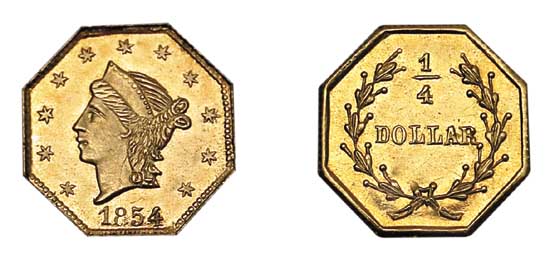
Obverse & Reverse
The 1854 BG-109 25 Cents is a quintessential artifact of the California Gold Rush, a period of frantic economic expansion that paradoxically created a severe crisis in commerce due to a lack of small-denomination coinage. Following the discovery of gold in 1848, hundreds of thousands of prospectors and merchants flooded into California, bringing with them a torrent of raw gold dust, nuggets, and large-denomination ingots. However, the daily transactions necessary for a functioning economy—buying a meal, a tool, or a drink—were severely hampered. Gold dust, measured in 'pinches,' was an inaccurate and often contentious medium of exchange. The U.S. government was slow to respond; the San Francisco Mint would not be fully operational until later in 1854 and even then, it focused on larger denominations. This monetary vacuum created a unique opportunity for private enterprise. Jewelers and metalworkers in San Francisco, possessing the requisite skills and equipment, began striking their own small-denomination coins in 1852. These 'California Fractional Gold' pieces, including the 25-cent, 50-cent, and one-dollar denominations, were not legal tender but were widely accepted out of sheer necessity. The BG-109 is classified as a 'Period One' issue (1852-1857), which are distinguished by their generally honest weight, high gold purity, and clear intent for use in circulation. Unlike later 'Period Two' and 'Three' issues, which were often underweight and made primarily as souvenirs, Period One pieces like the BG-109 were the lifeblood of retail trade in the boomtowns. They were crudely but effectively produced, typically by the hammer-striking method, resulting in significant variation in strike quality. Their existence was eventually curtailed by the Coinage Act of 1864, which prohibited private coinage, cementing their status as a fascinating, short-lived chapter in American monetary history.
Associated EventCalifornia Gold Rush
Reason For MintingTo alleviate a severe shortage of small-denomination coinage for everyday commerce in Gold Rush-era California.
Minter HistoryThe specific minter of the BG-109 variety is unknown, as was common for many of these early issues. The work is attributed generally to the community of skilled jewelers and metallurgists, many of French origin, operating in San Francisco during the 1850s. Individuals like Antoine Louis Nouizillet and partnerships such as Frontier & Deviercy (F.D.) are known to have produced similar pieces during this period. These craftsmen used their existing tools and expertise to meet a pressing commercial demand, effectively becoming private regional minters. Their operations ceased following the full establishment of the San Francisco Mint and the eventual enforcement of federal laws against private coinage.
Historical SignificanceThe BG-109 is historically significant as a tangible solution to a critical economic problem on the American frontier. It represents a period of private enterprise in minting that was essential for the growth of California's economy before federal services could be adequately established. As a Period One issue, it stands as an authentic circulating medium of exchange from the Gold Rush, not merely a souvenir, making it highly prized by numismatists studying territorial and private coinage.
N/A
Denomination25 Cents
Minting Period1854
Assayer/MinterUnknown San Francisco Jeweler
Geographic OriginSan Francisco, California
Obverse DescriptionFeatures a Liberty Head facing left, her hair tied in a bun. The portrait is somewhat crude, typical of these private issues. She is surrounded by 13 five-pointed stars along the periphery. The planchet is octagonal.
Obverse Inscription Reverse DescriptionA simple wreath of two branches tied with a bow at the bottom encircles the denomination. The date '1854' is positioned at the bottom, just below the wreath's bow. A beaded or dotted circle often appears inside the wreath.
Reverse Inscription1/4
CompositionGold
Stated FinenessNot stated, but Period One issues are generally of high purity native California gold.
Actual FinenessTypically .800 to .900 fine, often with a natural alloy of silver which can give some examples a lighter color.
Diameter9.50 mm
EdgePlain
Unknown
Survival Estimate31-75 (per R-5+ rating)
Rarity ScaleR-5+
This coin is highly sought after for its direct connection to the California Gold Rush, its status as a circulating Period One issue, and its distinctive octagonal shape. Its high rarity (R-5+) makes any example, especially in higher grades, a significant prize for collectors of pioneer gold.
Key VarietiesBG-109 is itself a specific die variety cataloged in the Breen-Gillio reference. No major sub-varieties are noted for this specific catalog number. No proof or special collector strikings were produced during the original minting period, as these were utilitarian issues. All known examples are considered business strikes.
Authentication TipsGenuine BG-109 pieces have a characteristic 'soft' strike and a specific die alignment. The style of the Liberty head and the numerals in the date are key diagnostics; compare with high-resolution images from major auction archives. Counterfeits and modern replicas abound. Many fakes are cast, showing porosity under magnification, or have a 'soapy' or incorrect luster. Others are underweight or made of brass. Authentic pieces were hammer-struck, often resulting in slightly uneven fields and strike weakness in certain areas. Familiarity with the die characteristics published in the Breen-Gillio reference is essential.
Shopping ConsiderationsWhen acquiring an 1854 BG-109, prioritize originality of the surfaces. Many examples have been cleaned, polished, or used in jewelry. A premium quality specimen for its grade will possess undisturbed, lustrous fields, often with a reddish or greenish-gold toning from the natural alloy. Sharpness of strike is a major value determinant; look for clear details in Liberty's hair and the leaves of the wreath. Weakness at the centers is common, but examples with a bold strike command significant premiums. Check the edges carefully for evidence of removal from a bezel or solder. Third-party certification by PCGS or NGC is highly recommended for this series due to the prevalence of counterfeits.
A coin's grade is its condition, rated on a 1-70 scale. For rare coins, this is the most critical factor in determining value, as a tiny difference in preservation can mean a huge difference in price.
Relevant Grade TypesAll original BG-109 coins are business strikes, created for circulation. They are found in Circulated grades (AG-3 to AU-58) and, more rarely, in Mint State (MS-60 to MS-70). No Proof examples were struck during the original period of issue, as these were functional, not presentation, pieces. Any piece described as a 'Proof' is likely a later-date replica or fantasy item.
Mint State CharacteristicsAn uncirculated BG-109 typically exhibits a soft, satiny luster rather than a hard, frosty one. The strike is often somewhat weak in the center of both the obverse and reverse, a result of being struck with a hammer on a small, thick planchet. The highest points, such as Liberty's hair and the wreath's bow, may not be fully defined even on a Gem example. High-grade examples are prized for their clean, mark-free fields and original 'skin.' A honey-gold or slightly reddish hue is characteristic of the native gold used.
Circulated Wear PatternsWear first appears on the highest points of the design. On the obverse, look for flattening on Liberty's cheek, the hair above the eye, and the ear. The surrounding stars will also begin to lose their sharpness. On the reverse, the high points of the wreath's leaves and the tie of the bow will show the first signs of friction. In lower grades (VG and below), the date and the fraction within the wreath can become faint and difficult to read.
Key Factors For ValueFor the BG-109, the primary value drivers are grade and surface originality. An example with original, uncleaned surfaces will always be worth more than a brighter, cleaned coin of the same technical grade. Strike quality is the next key factor; a coin with a sharp, well-centered strike is far more desirable than a weakly struck or off-center example. Finally, eye appeal, which includes factors like attractive toning and a lack of distracting marks, plays a major role. Given the high rarity, any certified problem-free example is valuable, but those with a CAC sticker, signifying premium quality for the grade, command the strongest prices.
PCGS Price Guide
| Grade | Price | Population |
|---|---|---|
| 55 | $375.00 | 2 |
| 55+ | $400.00 | N/A |
| 58 | $450.00 | 4 |
| 58+ | $475.00 | N/A |
| 60 | $525.00 | N/A |
| 61 | $575.00 | 2 |
| 62 | $650.00 | 10 |
| 62+ | $700.00 | N/A |
| 63 | $775.00 | 13 |
| 63+ | $850.00 | N/A |
| 64 | $1,050.00 | 11 |
| 64+ | $1,200.00 | N/A |
| 65 | $1,650.00 | 3 |
| 66 | N/A | N/A |