1854 G25C BG-216 (Regular Strike)
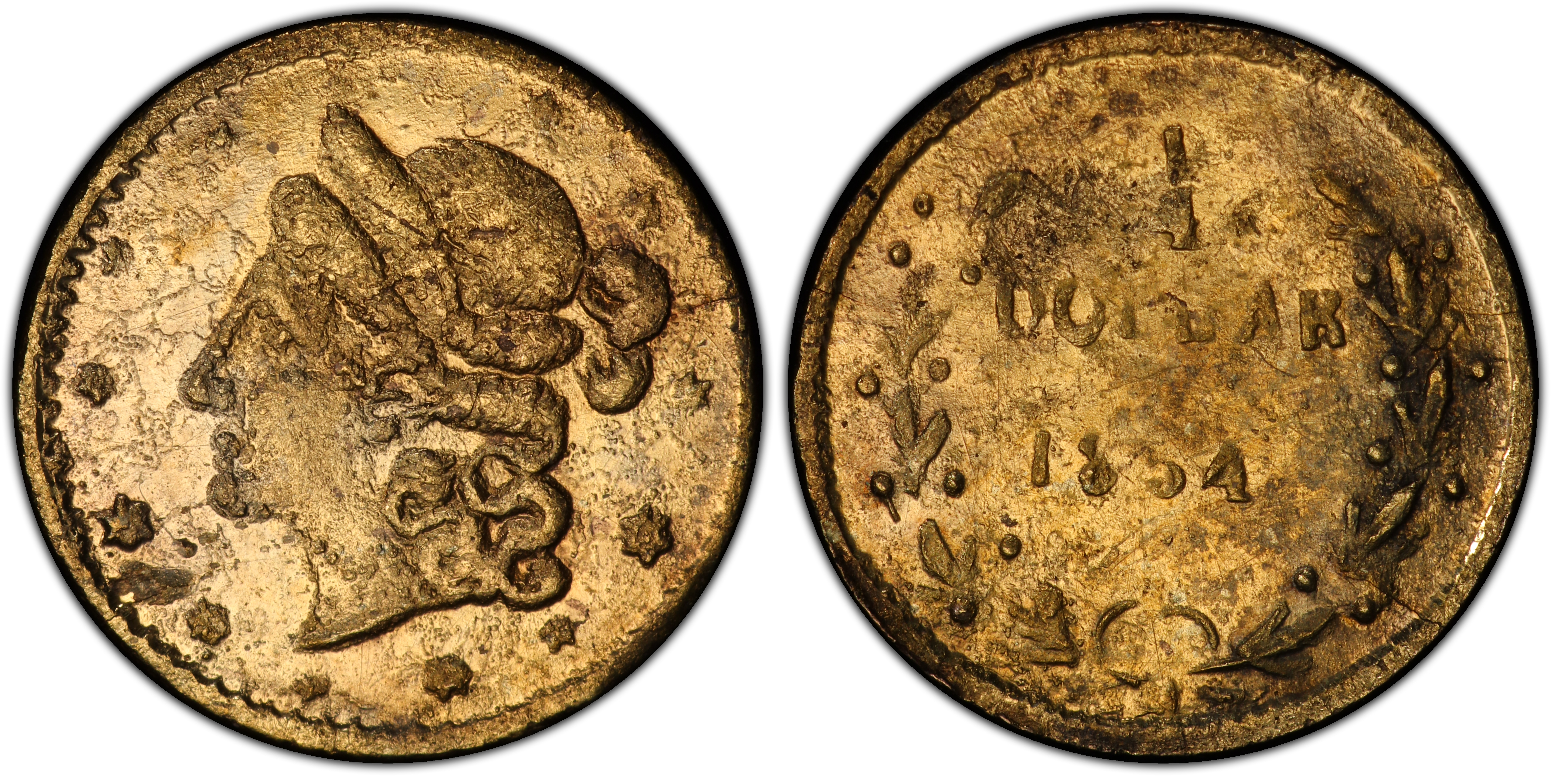
Obverse & Reverse
The 1854 25 Cents, cataloged as Breen-Gillio 216, is a quintessential artifact from the chaotic and economically vibrant zenith of the California Gold Rush. These diminutive gold pieces, today known as 'California Fractional Gold,' were born of pure necessity. The massive influx of prospectors and merchants into California following the 1848 discovery of gold at Sutter's Mill created a dynamic economy awash in gold dust but critically starved of small-denomination coinage for daily transactions. A 'pinch' of gold dust, the common medium of exchange for a drink or a small purchase, was an imprecise and often contentious system. While private firms like Moffat & Co. and Wass, Molitor & Co. produced larger denomination gold coins, the acute lack of fractional currency persisted. This void was filled by enterprising San Francisco jewelers, many of French origin, who began striking their own 25-cent, 50-cent, and one-dollar pieces starting in 1852. These initial issues, known as 'Period One' (1852-1857) fractionals, were intended for actual circulation. They were designed to mimic the appearance of the official U.S. Liberty Head gold dollars to foster public trust and acceptance. Evidence of their use in commerce is substantiated by their recovery from contemporary shipwrecks, such as the S.S. Central America, which sank in 1857 carrying treasure from the gold fields. The firm of Frontier, Deviercy & Co. was one of the key producers during this period. The BG-216 was struck using rudimentary techniques, likely a screw press or even a hammer, resulting in coins of varying strike quality. The gold itself was native California bullion, naturally alloyed with silver, giving the coins a lighter color than their federal counterparts. Despite their utility, these private issues were often underweight, a fact that eventually drew the scrutiny of authorities, especially after the San Francisco Mint began full-scale production of federal coinage in 1854. The increasing availability of official silver coins rendered the fractional gold pieces obsolete for circulation by 1857, ending the Period One era. Later issues (Period Two and Three) were produced primarily as souvenirs and are numismatically distinct. The BG-216 remains a tangible link to a specific solution for a unique economic problem in American history, representing the ingenuity and unregulated nature of the Gold Rush frontier.
Associated EventCalifornia Gold Rush
Reason For MintingTo alleviate a severe shortage of small-denomination coinage for everyday commercial transactions in Gold Rush-era San Francisco.
Minter HistoryPierre Frontier and Eugene Deviercy were San Francisco-based jewelers and goldsmiths active during the early 1850s. Like many of their contemporaries in the trade, they were likely of French origin. Their firm, Frontier, Deviercy & Co., was a notable producer of 'Period One' California Fractional Gold. They struck denominated pieces intended for circulation to meet the region's desperate need for small change. Their partnership was part of a small, competitive group of jewelers who essentially created an emergency, private coinage system that thrived until official U.S. Mint branch coinage became widely available in the mid-1850s. The firm is not known to have produced the later, souvenir-oriented 'Period Two' issues under this name.
Historical SignificanceAs a 'Period One' issue, the BG-216 is a genuine circulating medium of exchange from the height of the Gold Rush, not a later souvenir. It exemplifies the private sector's response to the failure of the federal government to supply adequate coinage to the rapidly growing California economy. Its existence is direct physical evidence of a unique chapter in American monetary history.
BG-216
Denomination25 Cents
Minting Period1854
Assayer/MinterFrontier, Deviercy & Co.
Geographic OriginSan Francisco, California
Obverse DescriptionA broad, left-facing bust of Liberty in the style of Christian Gobrecht's Coronet Head design used on contemporary federal gold coins. Her hair is tied in a bun, and she wears a coronet inscribed LIBERTY (though often not fully legible). The portrait is encircled by 13 small stars. This variety is known for being struck from a die that was reground and repolished to remove rust, leaving the field with a pock-marked or granular texture and often weakening the details.
Obverse InscriptionLIBERTY
Reverse DescriptionThe denomination '1/4 DOLLAR' and the date '1854' are enclosed within a fragmented wreath. The bow at the bottom is a simple circle, broken at the top. There is no fraction bar between the '1' and '4'. The '1' in the date is positioned below the 'D' of DOLLAR, and the final '4' is below and between the 'L' and 'A'.
Reverse Inscription1 4 DOLLAR 1854
CompositionGold
Stated Fineness Actual FinenessCirca .880 (Varies)
Weight0.40 grams
Diameter10.00 mm
EdgePlain
Unknown
Survival Estimate13-30 (R-6)
Rarity ScaleR-6
This variety is highly sought after as a genuine, circulating 'Period One' fractional. Its appeal lies in its direct connection to the Gold Rush economy, its high rarity, and the diagnostic challenge presented by its unique die characteristics, which tell the story of its manufacture.
Key VarietiesThe BG-216 is a distinct die marriage and has no major recognized sub-varieties from its original period of issue. It is a business strike intended for circulation. No proofs or special collector restrikes from the period are known to exist. The primary diagnostic is the obverse die state, which was heavily repolished to remove rust, resulting in a granular surface and weakened star details; the star above Liberty's coronet and the one below the bust are often virtually missing.
Authentication TipsGenuine BG-216 examples will exhibit a characteristic granular, slightly pock-marked surface texture on the obverse from the heavily polished rusty die. The strike will often appear soft, especially on the stars and the wreath. The specific placement of the date relative to 'DOLLAR' is a key diagnostic. Counterfeits are common in the series; they are often thicker, have a 'soapy' or cast appearance, incorrect weight, and may be made of brass or low-purity gold. Any piece lacking the denomination 'DOLLAR' is a later token or replica. Authentication by a leading third-party grading service is highly recommended.
Shopping ConsiderationsA premium quality example for its grade will show minimal distracting marks and retain some original luster, often frosty in texture. Given the known die state, a full strike is virtually impossible. A collector should seek an example where the date and denomination are as bold as possible and Liberty's main facial features are clear. The granular surface is characteristic of the issue and should not be confused with environmental damage. Avoid examples that have been harshly cleaned, which will appear unnaturally bright and show hairlines, or those that have been mounted in jewelry, which often show rim damage or evidence of solder removal. The natural reddish-gold or slightly pale yellow toning from the native California gold is highly desirable.
A coin's grade is its condition, rated on a 1-70 scale. For rare coins, this is the most critical factor in determining value, as a tiny difference in preservation can mean a huge difference in price.
Relevant Grade TypesAll original BG-216 specimens are business strikes intended for circulation and are found in grades from Circulated (AG-3 to AU-58) to Mint State (MS-60 to MS-70). No Proof examples were struck during the original minting period, and no later-date Proof restrikes are known for this specific variety. Any piece described as a 'Proof' is likely a modern replica.
Mint State CharacteristicsAn uncirculated BG-216 will exhibit frosty mint luster, though this may be muted by the die's granular surface. The strike is characteristically weak; do not expect to see sharp details on all 13 stars or a fully defined wreath. The key is the absence of wear and the presence of original texture. High points on the cheek and hair may show some flatness due to a weak strike, which should not be confused with circulation. Small, inherent planchet flaws are not uncommon due to the crude manufacturing process.
Circulated Wear PatternsWear first appears on the highest points: Liberty's cheek, the hair above her eye and ear, and the coronet. On the reverse, the leaves of the wreath and the numbers of the date will show initial friction and smoothing. In lower grades (VG and below), the stars will begin to merge with the fields, and the legends will become faint, with the date being one of the last elements to disappear entirely.
Key Factors For ValueFor the BG-216, value is driven by three main factors beyond the numerical grade. First is rarity; with only a small number known, any example is valuable. Second is surface quality; examples with original, uncleaned surfaces and attractive natural toning command significant premiums. Third is the strike; while always weak, coins that show clearer details on the date and Liberty's portrait are prized. The 'pock-marked' die state is a characteristic, but coins where this is less distracting are preferred. A CAC sticker is a significant value multiplier, confirming premium quality for the assigned grade.
PCGS Price Guide
| Grade | Price | Population |
|---|---|---|
| 50 | $425.00 | 1 |
| 50+ | $450.00 | N/A |
| 53 | $475.00 | N/A |
| 53+ | $500.00 | N/A |
| 55 | $550.00 | 3 |
| 55+ | $585.00 | N/A |
| 58 | $625.00 | N/A |
| 58+ | $750.00 | 1 |
| 60 | $825.00 | N/A |
| 61 | $900.00 | N/A |
| 62 | $1,500.00 | 12 |
| 62+ | $1,850.00 | N/A |
| 63 | $3,000.00 | 7 |
| 63+ | $3,500.00 | N/A |
| 64 | $4,500.00 | 2 |