1854 G$1 BG-509 (Regular Strike)
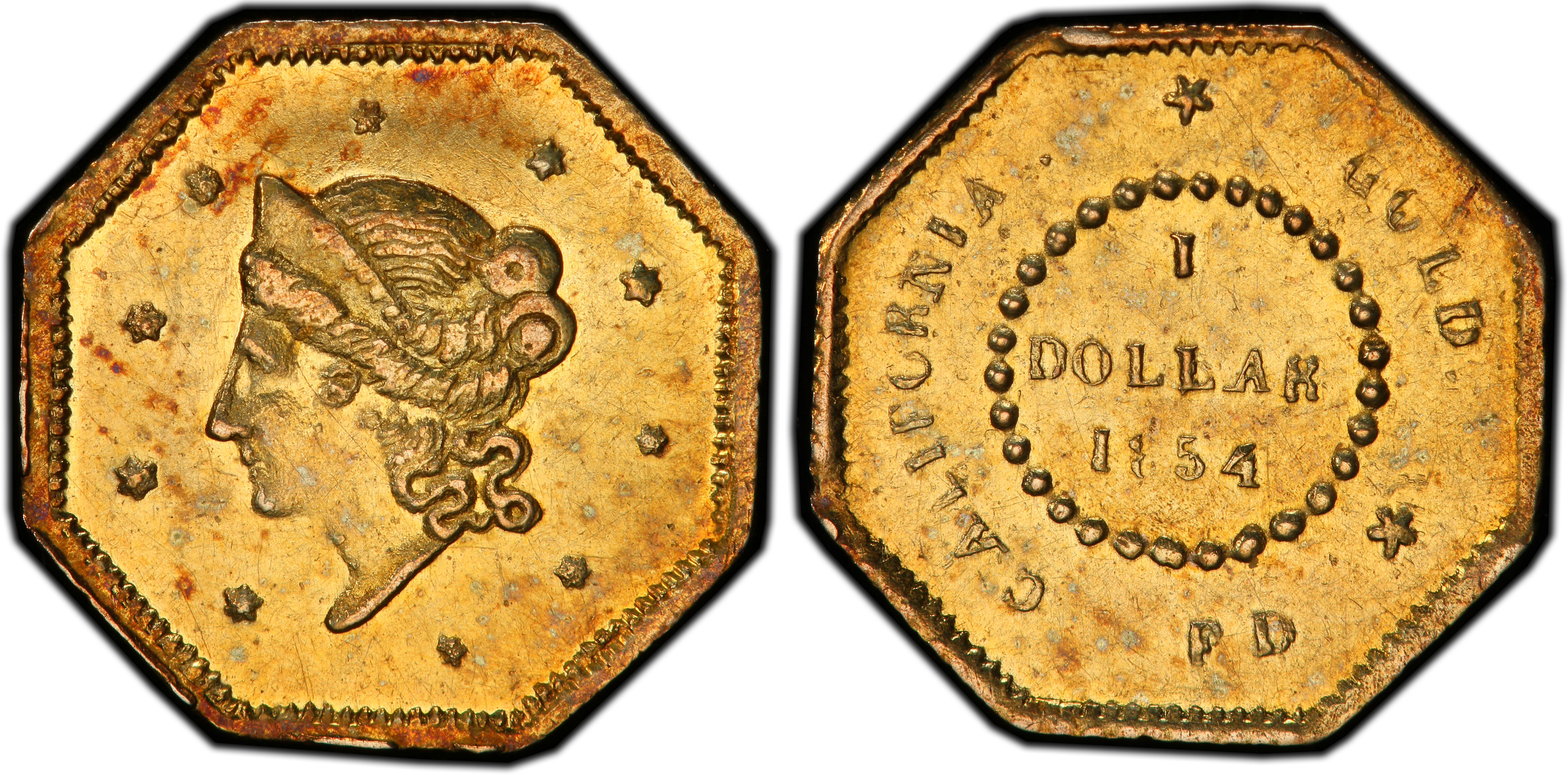
Obverse & Reverse
The 1854 BG-509 octagonal dollar is a tangible relic from the chaotic and economically vibrant zenith of the California Gold Rush. Following the discovery of gold at Sutter's Mill in 1848, a massive influx of prospectors and merchants flooded into California, creating a burgeoning economy almost overnight. However, this rapid growth far outpaced the supply of official United States coinage. Gold dust, weighed in 'pinches,' became the default medium of exchange, but it was an imprecise, cumbersome, and often contentious method for daily transactions. The need for a reliable, small-denomination currency was acute. While several private firms began minting larger gold coins ($5 and up), the scarcity of currency for minor purchases—a loaf of bread, a drink at a saloon—crippled local commerce. Into this void stepped numerous enterprising jewelers and metalsmiths in booming San Francisco. Between 1852 and 1857, a period numismatists now classify as 'Period One,' these private minters produced fractional gold coins in 25c, 50c, and $1 denominations. These were not government-sanctioned issues but were generally accepted in trade out of sheer necessity. Their intrinsic value was often slightly less than their face value, making them technically tokens, but their utility was undeniable. The firm of Frontier, Deviercy & Co., one of the more prolific and higher-quality producers of this era, created the BG-509. These pieces were struck by hand, using a hammer and anvil to impress the designs from hand-cut dies onto small gold planchets. This manual process resulted in coins that were often imperfect, with weak or uneven strikes, but they served their purpose. The opening of the San Francisco Mint in April 1854 signaled the beginning of the end for these private issues. As official federal coinage began to circulate more widely by 1856-1857, the necessity for fractional gold waned, and most pieces were eventually withdrawn, melted, or lost. The BG-509's high rarity today is a direct result of this brief, intense period of circulation and subsequent high attrition rate.
Associated EventCalifornia Gold Rush
Reason For MintingTo alleviate a severe shortage of small-denomination coinage for daily commercial transactions in Gold Rush-era California.
Minter HistoryPierre Frontier and Eugene Deviercy were French jewelers who formed a partnership in San Francisco, operating from 1852 to 1856. They were among the most significant and respected private minters of 'Period One' California fractional gold. Their products, often marked with an 'F.D.' monogram, were known for relatively consistent quality and design. They produced a wide variety of octagonal and round quarter, half, and dollar denominations. The partnership's workmanship was generally superior to many of their contemporaries, featuring well-executed Liberty heads and cleaner die work. After the fractional gold boom subsided, the firm underwent several changes, but their original 'Period One' issues remain the most sought-after by numismatists.
Historical SignificanceThe BG-509 and its contemporaries are historically significant as a form of 'emergency money' that enabled the day-to-day economy of the American West's most explosive period of growth. They represent the ingenuity and adaptability of private enterprise in the absence of sufficient government infrastructure. As a 'Period One' issue, it is a genuine artifact of commerce from the Gold Rush, unlike later 'Period Two' pieces which were primarily made as souvenirs.
N/A
Denomination$1
Minting Period1854
Assayer/MinterFrontier, Deviercy & Co.
Geographic OriginSan Francisco, California
Obverse DescriptionFeatures a Liberty Head portrait facing left, stylistically imitative of the official U.S. Type 1 Gold Dollar by James B. Longacre. The portrait is relatively large and bold for the planchet size. Thirteen stars, representing the original colonies, encircle the portrait within the octagonal border. On this specific variety, the stars are sharply defined but somewhat crudely shaped, and their placement relative to Liberty's features is a key diagnostic.
Obverse Inscription Reverse DescriptionThe reverse is dominated by the denomination '1' and the word 'DOLLAR' within a simple, beaded circle or wreath-like element. The date '1854' is positioned below the denomination. The letters F.D. for Frontier & Deviercy appear on some of the firm's issues, but are not a prominent feature of the BG-509 reverse design itself, which is defined by the arrangement of the date and denomination within a circle of dots.
Reverse Inscription1 DOLLAR 1854
CompositionGold
Stated Fineness Actual FinenessTypically varied from 14 to 22 karats; Period One issues were generally of higher fineness than later souvenir pieces, though often slightly debased with native silver.
EdgePlain
Unknown, but presumed to be very small, consistent with other hand-struck issues of the period.
Survival Estimate13-30 coins known.
Rarity ScaleR-6
The BG-509 is highly prized as a genuine 'Period One' circulating issue from a famous maker. Its octagonal shape, high rarity (R-6), and direct connection to the peak of the California Gold Rush make it a cornerstone collectible for specialists in territorial gold and Western Americana.
Key VarietiesNo major varieties are known for the BG-509 die marriage. Unlike some other fractional gold issues, there are no known contemporary restrikes or later souvenir strikes made from these specific dies. The variety is defined by its single known die pairing.
Authentication TipsAuthentication requires comparison with known genuine examples, ideally through third-party grading. Key diagnostics include the precise positioning of the 13 obverse stars relative to Liberty's portrait, the specific font and spacing of the reverse date and legend, and the characteristic crude but sharp overall appearance. Look for a natural, slightly soft luster consistent with Gold Rush-era metallurgy; modern fakes often have a brassy, hard, or overly prooflike finish. Genuine pieces are struck, not cast, so look for striking characteristics, not casting bubbles or seams. Any piece featuring a bear on the reverse is a modern token, not an authentic fractional gold coin.
Shopping ConsiderationsFor a premium quality BG-509, a potential buyer should prioritize a bold, well-centered strike. Given the crude hammer-striking process, many examples are weakly struck, especially at the borders. A coin with a full Liberty portrait and clear date and legends commands a significant premium. Original, uncleaned surfaces are paramount; many surviving examples have been cleaned, polished, or used as jewelry. Look for coins with a residual soft, satiny luster and a natural, attractive reddish-gold or mellow yellow-gold patina. Avoid examples with significant scratches, rim bumps, or any signs of tooling or repair. Certification by PCGS or NGC is virtually mandatory for a transaction of this rarity and value.
A coin's grade is its condition, rated on a 1-70 scale. For rare coins, this is the most critical factor in determining value, as a tiny difference in preservation can mean a huge difference in price.
Relevant Grade TypesAll original 1854 BG-509 dollars were struck as business strikes intended for commerce and are found in Circulated (1-58) and, very rarely, Mint State (MS, 60-70) grades. No Proofs were struck during the original period of issue. Any piece described as a 'Proof' would be a modern creation or a misattribution of a prooflike business strike.
Mint State CharacteristicsA true Mint State BG-509 is exceptionally rare. Quality is defined by the strength of the strike; a sharp strike across the high points of Liberty's hair and the stars is highly desirable but seldom seen. Luster is typically soft and satiny, not deeply prooflike. Due to the hand-hammering process and the softness of the gold, even uncirculated examples can be expected to have some minor planchet flaws or contact marks from being handled with other coins in the 1850s. A clean, mark-free surface with strong luster and strike would be considered a pinnacle example.
Circulated Wear PatternsWear first appears on the highest points of the design. On the obverse, look for friction on Liberty's cheek, the hair just above her eye, and the coronet. On the reverse, the numeral '1' and the letters in 'DOLLAR' will show initial flatness. In lower grades (VG and below), the stars on the obverse will begin to merge with the fields, and the date on the reverse may become faint or partially illegible.
Key Factors For ValueFor the BG-509, the primary value drivers are rarity and grade. However, within a given grade, eye appeal is crucial. An example with a sharp strike, original surfaces, and pleasing, even coloration will sell for a substantial premium over a weakly struck, cleaned, or scratched coin of the same numerical grade. Third-party certification is essential, and a sticker from CAC (Certified Acceptance Corporation) indicating premium quality for the grade would add a significant further premium.
PCGS Price Guide
| Grade | Price | Population |
|---|---|---|
| 30 | $1,200.00 | 1 |
| 35 | $1,250.00 | N/A |
| 40 | $1,350.00 | N/A |
| 45 | $1,450.00 | 1 |
| 45+ | $1,500.00 | N/A |
| 50 | $1,700.00 | 5 |
| 50+ | $1,850.00 | N/A |
| 53 | $1,950.00 | 1 |
| 53+ | $2,100.00 | N/A |
| 55 | $2,250.00 | 5 |
| 55+ | $2,500.00 | N/A |
| 58 | $2,850.00 | 1 |
| 58+ | $3,100.00 | N/A |
| 60 | $3,250.00 | N/A |
| 61 | $3,750.00 | 3 |
| 62 | $5,000.00 | 5 |
| 62+ | $5,750.00 | N/A |
| 63 | $7,000.00 | 1 |