1865/4 25C BG-736 (Regular Strike)
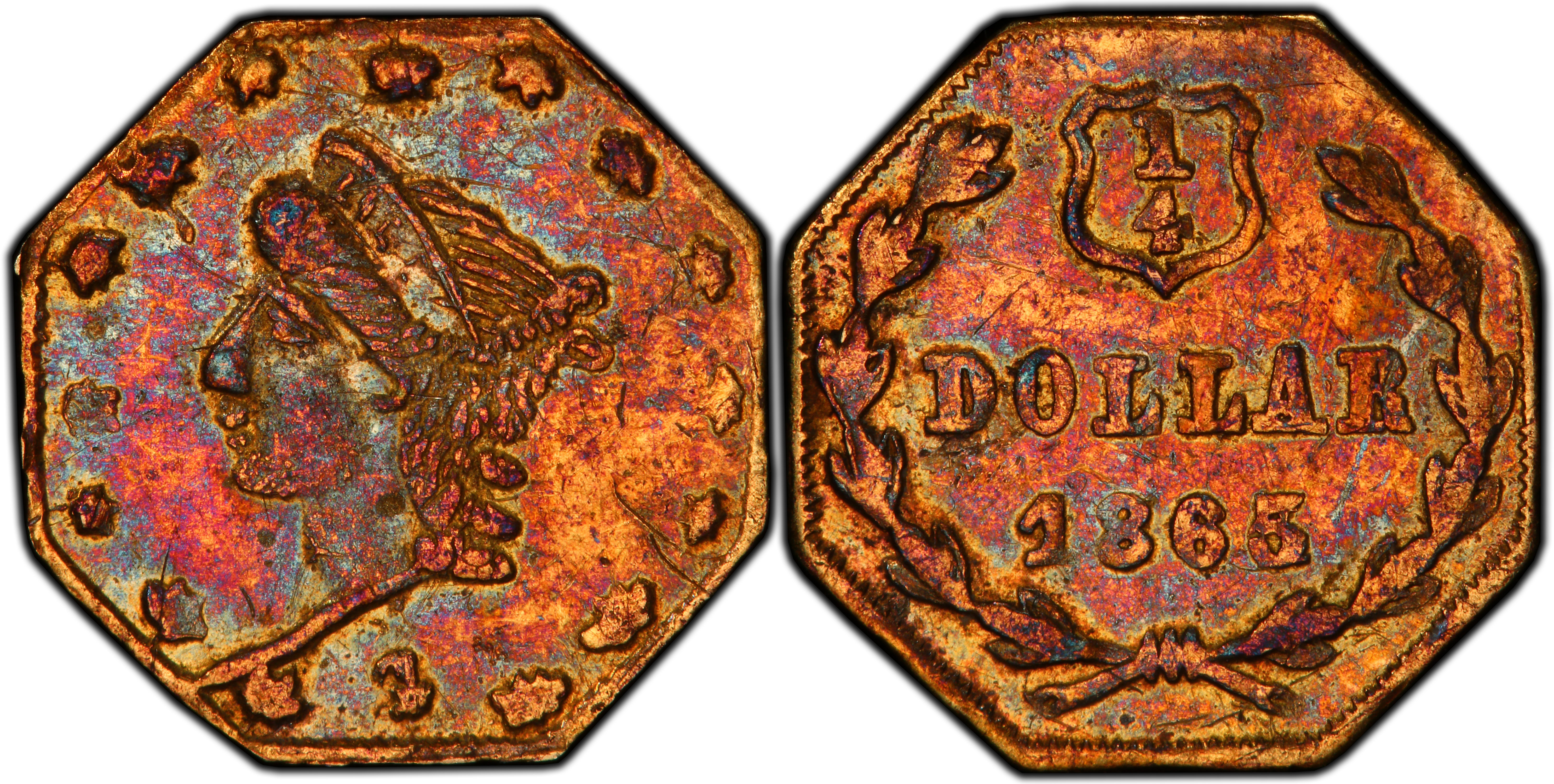
Obverse & Reverse
The 1865/4 25 Cents, cataloged as BG-736, is a quintessential example of 'Period Two' California Fractional Gold. By the mid-1860s, the initial, acute shortage of small change that characterized the early Gold Rush had been largely resolved by the output of the San Francisco Mint. The raison d'être for fractional gold had shifted from necessity to novelty. These diminutive gold pieces were no longer primarily instruments of commerce but were instead produced by jewelers as souvenirs, keepsakes, and curiosities for tourists and locals enchanted by the romance of the Gold Rush. This variety, struck by the firm of Robert B. Gray & Co. in San Francisco, is a fascinating numismatic artifact of this transitional period. The coin exhibits an overdate, with the digit '5' clearly punched over a '4' in the die, a common practice among private minters to economize and reuse existing dies. The dies used for BG-736 were, according to Breen and Gillio, 'drastically repolished,' likely to efface clash marks or extend their usable life. This heavy polishing resulted in a distinctive and consistent appearance across surviving examples: a weakly defined portrait of Liberty, stars that appear as indistinct blobs, and a generally soft strike. This was not a result of carelessness but rather a reflection of their intended market; precision and intrinsic value were secondary to their function as affordable mementos. The Private Coinage Act of April 22, 1864, had already outlawed the issuance of private coins, but enforcement was lax, particularly for these small, low-value tokens which were not seen as a significant threat to federal currency. Production continued, albeit somewhat clandestinely, for nearly two more decades. The BG-736, with its mid-war date and recycled die, tells the story of a cottage industry adapting to a new economic reality, its products cherished more for their symbolism than their utility in daily transactions.
Associated EventPost-Gold Rush Era / American Civil War
Reason For MintingPrimarily struck to be sold as souvenirs and keepsakes rather than to fill a commercial need for circulating coinage.
Minter HistoryRobert B. Gray & Co. was a prominent San Francisco jewelry firm active in the production of California Fractional Gold during 'Period Two' (1859-1882). Around 1859, Gray acquired the business and equipment of another fractional gold maker, Antoine Louis Nouizillet. Gray continued to use some of Nouizillet's dies but also created his own, often marked with a 'G'. Gray's issues are generally noted for being of higher weight and intrinsic value compared to many other 'jeweler's issues' of the period. The firm was a prolific producer until Gray sold his interests to the California Jewelry Co. in 1871.
Historical SignificanceBG-736 is significant as it represents the evolution of fractional gold from a circulating medium of necessity to a commercial souvenir product. Its manufacturing characteristics, such as the overdate and heavily polished dies, provide direct insight into the production methods and economic motives of private minters in San Francisco during the Civil War era, after federal laws had officially prohibited such activities.
BG-736
Denomination25C
Minting Period1865
Assayer/MinterRobert B. Gray & Co.
Geographic OriginSan Francisco, California
Obverse DescriptionA crude, softly defined Liberty Head facing left, her hair tied in a bun. The portrait is surrounded by thirteen misshapen, blob-like stars. The date, 1865/4, is below the bust, with the '5' clearly punched over the '4'. The tip of the bust often extends to the rim due to the lapped dies.
Obverse Inscription1865/4
Reverse DescriptionThe denomination '25 CENTS' enclosed within a simple wreath. The wreath is tied with a bow at the bottom.
Reverse Inscription25 CENTS
CompositionGold
Stated Fineness Actual FinenessTypically 14 to 22 karats for Period Two issues.
Weight0.24 grams
Diameter9.60 mm
EdgePlain
Unknown
Survival Estimate30-50 coins known
Rarity ScaleR-6
This variety is highly sought after by specialists for its clear 1865/4 overdate, its distinctive die characteristics (lapped portrait, blob stars), and its status as a scarce R-6 variety. It is an essential piece for collectors of overdates and major Breen-Gillio varieties.
Key VarietiesThe primary variety is the 1865/4 overdate business strike. No proof strikings or later restrikes are known to exist for the BG-736 variety. The key variation is in the state of the dies, though all known examples are from the same late, heavily polished die state.
Authentication TipsAuthentic examples must exhibit the characteristic features of the heavily polished dies: a lapped portrait with a flattened, indistinct look, and stars that are more like round blobs than defined stars. The overdate should be clear under magnification. The weight and diameter should be close to the norms for the type. Modern counterfeits often have sharper details, incorrect weight, or a soapy, cast-like surface. Compare any potential purchase to high-resolution images of certified examples.
Shopping ConsiderationsA 'premium quality' example for this variety is not defined by a sharp strike, which is non-existent. Instead, buyers should seek out coins with smooth, problem-free surfaces that retain some degree of original mint luster, often appearing as prooflike or mirrored fields due to the polished dies. Look for minimal contact marks and avoid examples that have been harshly cleaned, which can obliterate the delicate original surfaces. The clarity of the overdate is a key value point. Any evidence of having been mounted in jewelry should be cause for a significant discount. Given the inherent softness of the strike, grade is often determined more by surface preservation than by wear.
A coin's grade is its condition, rated on a 1-70 scale. For rare coins, this is the most critical factor in determining value, as a tiny difference in preservation can mean a huge difference in price.
Relevant Grade TypesAll original examples of BG-736 are business strikes, produced for souvenir sales rather than circulation. They are found in Circulated grades (AU-50 to AU-58 are most common) and Mint State (MS, 60-70). No proofs were struck during the original period of issue, and no later-date restrikes are known.
Mint State CharacteristicsAn uncirculated (MS) BG-736 is defined by its surface preservation, not strike. A high-grade example will exhibit bright, often mirrored or prooflike fields from the polished dies. The strike is characteristically blunt and weak; the portrait is lapped and lacks fine detail, and the stars are simple blobs. This is normal and expected. Luster should be unbroken. Contact marks are the primary determinant of grade, as the soft gold is easily nicked.
Circulated Wear PatternsWear first appears on the highest points of Liberty's hair and cheek. On the reverse, the highest leaves and the bow of the wreath will show the first signs of friction. In lower grades (VF and below, though rarely seen), the date and legends will begin to weaken, although they are already softly defined from the strike.
Key Factors For ValueFor the BG-736 variety, value is driven by three main factors: 1) Surface Quality: Coins with clean, original surfaces and reflective fields are prized over those with hairlines, scratches, or evidence of cleaning. 2) Grade: The numerical grade (especially the jump from AU to MS) has a major impact on price. 3) Eye Appeal: Even within a grade, a coin with attractive, unimpaired surfaces will command a premium. A CAC sticker is highly desirable for this issue as it confirms premium quality for the assigned grade.
PCGS Price Guide
| Grade | Price | Population |
|---|---|---|
| 35 | $215.00 | 1 |
| 40 | $240.00 | 1 |
| 45 | $250.00 | 1 |
| 45+ | $260.00 | N/A |
| 50 | $275.00 | 3 |
| 50+ | $280.00 | N/A |
| 53 | $290.00 | 1 |
| 53+ | $295.00 | N/A |
| 55 | $300.00 | 2 |
| 55+ | $330.00 | N/A |
| 58 | $400.00 | 3 |
| 58+ | $420.00 | N/A |
| 60 | $500.00 | 1 |
| 61 | $575.00 | 2 |
| 62 | $700.00 | 6 |
| 62+ | $900.00 | N/A |
| 63 | $1,250.00 | 3 |
| 63+ | $1,750.00 | N/A |
| 64 | $3,000.00 | 1 |