1856 G25C BG-229 (Regular Strike)
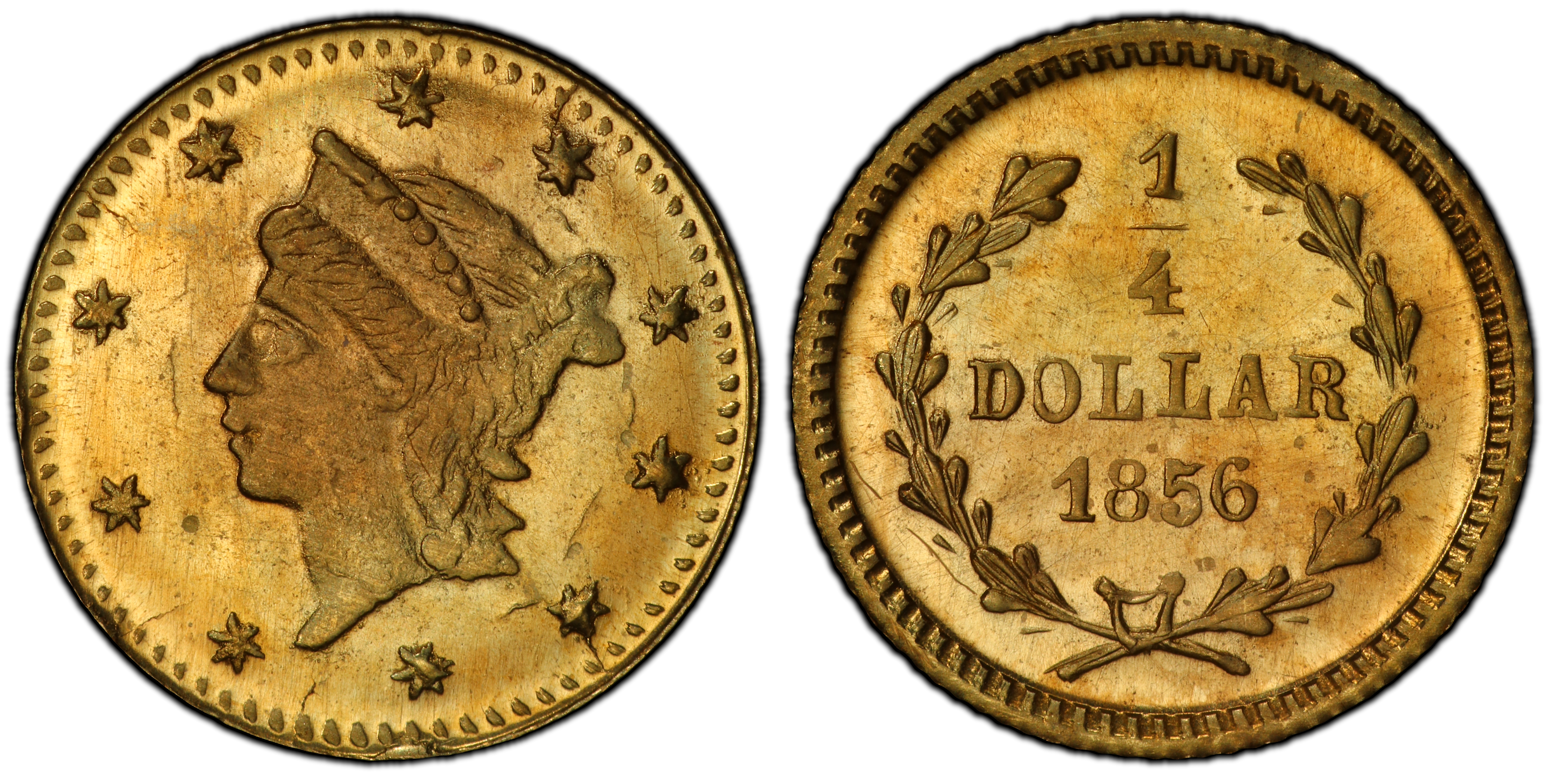
Obverse & Reverse
The 1856 Round 25 Cents, cataloged as Breen-Gillio 229, is a quintessential artifact from the first period (1852-1857) of California's private gold coinage era. Its existence is a direct consequence of the massive influx of population and gold dust following the 1848 discovery at Sutter's Mill. While the newly established San Francisco Mint began operations in 1854, it initially focused on larger denominations, leaving a severe and persistent shortage of small denomination coins for daily commerce. Simple transactions like buying a drink or a meal were complicated, often resorting to imprecise measures of gold dust. Responding to this commercial vacuum, numerous private minters, predominantly jewelers and metallurgists in San Francisco, began striking their own fractional denomination gold coins. These Period One issues, including BG-229, were generally made with an honest attempt to contain their face value in gold and were intended for actual circulation. They mimicked the design of federal coinage, featuring a Liberty Head, to foster public trust and acceptance. The BG-229, struck in the final year of this initial period, represents the culmination of this unregulated but necessary practice. By the end of 1856, the San Francisco Mint had ramped up production of federal silver and gold coins, alleviating the small change crisis and rendering the private issues largely obsolete for transactional purposes. Many were subsequently melted, lost, or kept as curiosities, beginning their transition from vital pocket change to treasured numismatic relics. The specific artisan or firm responsible for the BG-229 die pair remains unidentified, a common fate for many of these small issues whose makers often preferred anonymity to avoid potential legal conflicts with federal authorities over the right to coin money.
Associated EventCalifornia Gold Rush
Reason For MintingTo alleviate a severe shortage of small-denomination coinage for everyday commercial transactions in Gold Rush-era California.
Minter HistoryThe specific minter or jeweler who produced the BG-229 variety is unknown. Period One fractional gold coins were struck by a number of different private firms and individuals in San Francisco, many of French origin, such as Antoine Louis Nouizillet and the partnership of Frontier & Deviercy. These artisans used their metallurgical and engraving skills to meet the public's demand for coinage, but often left their products unmarked, leaving precise attribution for many varieties, including BG-229, a challenge for modern numismatists.
Historical SignificanceAs a 'Period One' issue, the BG-229 is a genuine remnant of the commercial landscape of the California Gold Rush, representing a private solution to a government failure in providing adequate coinage. Its existence demonstrates the autonomy and ingenuity of frontier economies and it serves as a tangible link to the daily life of miners, merchants, and settlers in one of America's most dynamic historical periods.
BG-229
Denomination25 Cents
Minting Period1856
Assayer/MinterUnknown Private Minter
Geographic OriginSan Francisco, California
Obverse DescriptionA small, crudely rendered Liberty Head facing left, modeled after the contemporary federal gold dollar. The portrait is encircled by ten five-pointed stars, which are often weakly struck or unevenly spaced.
Obverse Inscription Reverse DescriptionThe denomination '1/4 DOLLAR' and the date '1856' are enclosed within a simple, open-ended wreath. The wreath is composed of two branches tied with a bow at the bottom. The lettering and numerals are typically functional rather than artistic, and may show variable strike depth.
Reverse Inscription1/4 DOLLAR 1856
CompositionGold
Stated Fineness Actual FinenessPeriod One issues were generally struck from native California gold, which naturally contained silver. Fineness varied but was typically lower than federal standards, often ranging from .800 to .900.
Weight0.38 grams
Diameter9.70 mm
EdgePlain
0
Survival Estimate75-125
Rarity ScaleR-4
The BG-229 is highly sought after as a representative 'Period One' issue, prized for its genuine connection to the Gold Rush economy. Its small size, historical importance, and relative scarcity make it a classic and challenging collectible within the popular California Fractional Gold series.
Key VarietiesThere are no major, recognized varieties of BG-229 from the original minting period. The primary variations among surviving examples relate to strike quality, planchet texture (some exhibit parallel striations), and minor die states. No later-date restrikes or special collector issues of this specific variety are known to exist.
Authentication TipsAuthentic BG-229 examples will exhibit die characteristics consistent with known genuine specimens; consult high-resolution images from major auction archives. The strike is often somewhat crude, but the details should not be mushy or indistinct like many modern replicas. Genuine pieces are struck in gold, not brass or other alloys, and will have a correct specific gravity. Beware of modern copies, often called 'jeweler's copies' or tokens, which frequently feature a bear on the reverse or have a different design style and are typically underweight or made of base metal. Third-party certification is highly recommended for this series.
Shopping ConsiderationsA premium quality example for its grade will show a bold strike, particularly on the stars and the date, which are often weak. Look for clean, original surfaces with minimal distracting marks. Luster is a key value determinant; examples with prooflike or semi-prooflike fields command significant premiums. The natural gold color can range from a buttery yellow to a slightly reddish or greenish-gold hue due to alloy variations; attractive original color is highly desirable. Avoid examples that have been harshly cleaned, which strips the original patina, or those that show evidence of being used in jewelry, such as solder marks or rim damage.
A coin's grade is its condition, rated on a 1-70 scale. For rare coins, this is the most critical factor in determining value, as a tiny difference in preservation can mean a huge difference in price.
Relevant Grade TypesOriginal 1856 BG-229 coins were business strikes intended for circulation and are found in Circulated grades (AG-3 to AU-58) and Mint State grades (MS-60 to MS-70). No true Proofs were struck during the original period of issue. The term 'Prooflike' (PL) is sometimes applied by grading services to Mint State examples with unusually reflective, mirror-like surfaces, and these are highly prized.
Mint State CharacteristicsUncirculated examples are scarce. Quality is defined by the strength of the strike; a sharp strike on the Liberty Head's coronet, the stars, and the reverse wreath and date is paramount. Luster is typically satiny and can sometimes be deeply reflective (prooflike). Due to the minting process and soft gold, even high-grade Mint State examples will often exhibit minor planchet striations or small, scattered contact marks. A clean cheek on Liberty is a key focal point.
Circulated Wear PatternsWear first appears on the highest points of the design. On the obverse, check for flatness on Liberty's hair above the eye and on the coronet. The stars, particularly those opposite the portrait, will also lose their sharpness. On the reverse, the high points of the wreath's leaves and the bow will show initial wear. In lower grades (VG and below), the date and legends become weak and may merge with the fields.
Key Factors For ValueFor the BG-229, the primary value drivers are grade and surface quality. An example with original, uncleaned surfaces will always be worth more than a cleaned coin of the same grade. Strike sharpness is critical; well-struck coins with full details can trade for double a weakly struck counterpart. Eye appeal, encompassing attractive color and minimal marks, is also a major factor. Coins certified by top-tier services like PCGS or NGC command the strongest prices, and a CAC sticker, indicating premium quality for the grade, adds a significant premium.
PCGS Price Guide
| Grade | Price | Population |
|---|---|---|
| 40 | $210.00 | N/A |
| 45 | $220.00 | N/A |
| 45+ | $225.00 | N/A |
| 50 | $235.00 | 1 |
| 50+ | $245.00 | N/A |
| 53 | $255.00 | 1 |
| 53+ | $265.00 | N/A |
| 55 | $275.00 | 7 |
| 55+ | $300.00 | N/A |
| 58 | $375.00 | 13 |
| 58+ | $400.00 | N/A |
| 60 | $425.00 | 4 |
| 61 | $450.00 | 5 |
| 62 | $475.00 | 51 |
| 62+ | $500.00 | N/A |
| 63 | $525.00 | 36 |
| 63+ | $575.00 | N/A |
| 64 | $800.00 | 14 |
| 64+ | $950.00 | 1 |
| 65 | $2,100.00 | 2 |
| 65+ | $2,400.00 | N/A |
| 66 | $3,000.00 | 4 |
| 66+ | $3,500.00 | 1 |