1853 G$1 BG-520 (Regular Strike)
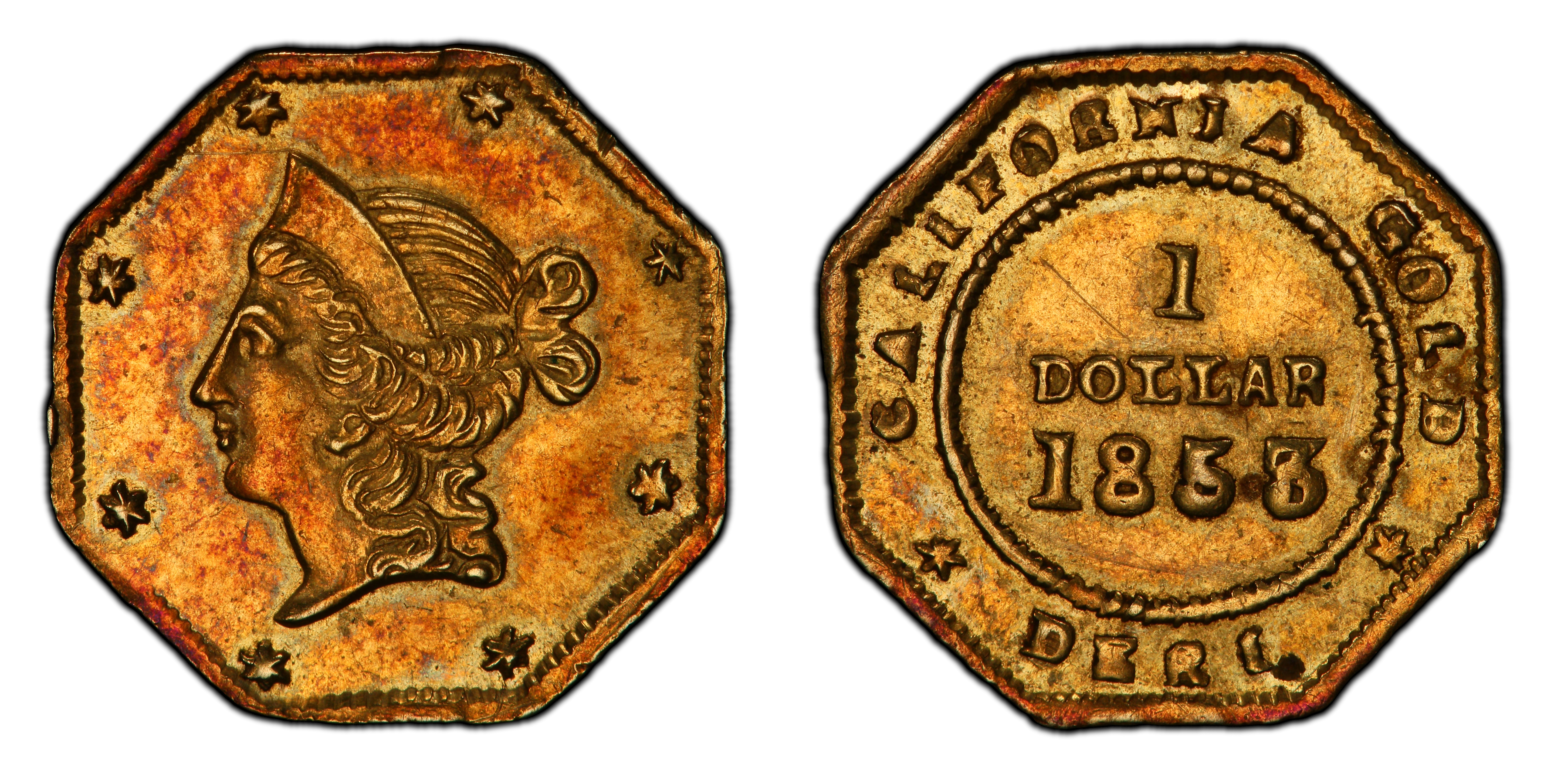
Obverse & Reverse
The 1853 G$1 BG-520 is a numismatic artifact of immense rarity, born from the chaotic and economically volatile crucible of the California Gold Rush. Following the discovery of gold at Sutter's Mill in 1848, a massive influx of prospectors and merchants descended upon California, creating a vibrant but haphazard economy. Gold dust, the primary medium of exchange, was imprecise and inconvenient for small, everyday transactions. This created a severe shortage of small-denomination coinage, a void the federal government was slow to fill; the San Francisco Mint would not begin operations until 1854. In response to this critical commercial need, a number of private manufacturing jewelers in San Francisco began striking their own coinage in 1852. These pieces, known as 'Period One' (1852-1857) California Fractional Gold, were intended to, and did, circulate as currency. The BG-520 dollar, attributed to the French jeweler Antoine Louis Nouizillet, is a prime example of this fascinating genre. Struck in 1853, it represents a period when private minters were at their peak, producing octagonal and round coins that mimicked federal designs to inspire public confidence. These coins were typically hammered—a process where a top die was struck with a sledgehammer onto a planchet resting on a bottom die—resulting in strikes of varying quality. Despite their utility, these fractional pieces were technically illegal, as the U.S. Constitution grants coinage authority solely to the federal government. Furthermore, most were significantly underweight, containing less than their face value in gold, making them a highly profitable venture for their makers. The BG-520 is a ghost of this era; its extreme rarity (R-8) suggests a minuscule original mintage, perhaps as a trial or part of a very small, rapidly withdrawn batch. The few surviving examples are treasured relics, tangible links to a time when the desperate need for a functional currency in the West was met by entrepreneurial, and perhaps opportunistic, private enterprise.
Associated EventCalifornia Gold Rush
Reason For MintingTo alleviate a severe shortage of small-denomination coinage for everyday commercial transactions in Gold Rush-era San Francisco.
Minter HistoryAntoine Louis Nouizillet was a prominent French jeweler and watchmaker who operated in San Francisco during the 1850s. He was a key figure in the production of 'Period One' fractional gold, both independently and in partnerships, including 'Deriberpe and Nouizillet' (D.N.) and 'Nouizillet and Routhier' (N.R.). His operations were a direct response to the local economy's desperate need for small change. Nouizillet's business was prolific but short-lived in the context of minting; around 1859-60, as federal coinage became more plentiful and the utility of private issues waned, he sold his business, including his dies, hubs, and punches, to another jeweler, Robert B. Gray. This sale led to some of Nouizillet's original dies being used for later 'Period Two' souvenir restrikes, a common practice in the series.
Historical SignificanceThe BG-520 is an ultimate rarity from the 'Period One' issues of California Fractional Gold, representing the peak of private efforts to create a circulating medium of exchange before the establishment of the San Francisco Mint. Its existence underscores the critical shortage of coinage and the vital role of jewelers in the Gold Rush economy.
N/A
DenominationG$1
Minting Period1853
Assayer/MinterAntoine Louis Nouizillet
Geographic OriginSan Francisco, California
Obverse DescriptionThe obverse features a small, classic Liberty Head facing left, her hair tied in a bun. The portrait is encircled by thirteen stars, representing the original colonies. The date, 1853, is positioned below the truncation of the neck. The style of the bust and stars is characteristic of Nouizillet's work from this period.
Obverse Inscription1853
Reverse DescriptionThe reverse design consists of the denomination '1 DOLLAR' within a wreath. The wreath is composed of two branches tied together by a bow at the bottom. The legend 'CALIFORNIA GOLD' appears around the upper periphery, outside the wreath. Specific die markers for the BG-520 are exceptionally subtle and require high-magnification comparison to known genuine examples, given its extreme rarity.
Reverse InscriptionCALIFORNIA GOLD 1 DOLLAR
CompositionGold
Stated Fineness Actual FinenessTypically .800 to .900, alloyed with native silver.
Weight1.10 grams
Diameter13.00 mm
EdgePlain
Extremely low; likely less than 25.
Survival Estimate2-3 known
Rarity ScaleR-8
As an R-8 'Period One' issue, the BG-520 is one of the ultimate prizes in the entire field of U.S. private and territorial gold. Its appeal lies in its nearly unattainable rarity, its direct connection to the authentic commercial needs of the Gold Rush, and its status as a pinnacle piece for the advanced specialist. Owning a BG-520 signifies a collection of the highest caliber.
Key VarietiesThere are no known major varieties of the BG-520 from its original minting period. As a 'Period One' issue, it was struck for circulation. While Antoine Louis Nouizillet's dies were sold to Robert B. Gray & Co. who produced later restrikes of some varieties, there are no known or documented restrikes specific to the BG-520 die marriage. The coin stands as a singular, original issue.
Authentication TipsAuthentication of a purported BG-520 would be a monumental task requiring direct comparison with one of the few known, authenticated examples. Key diagnostics would include precise die characteristics, such as the exact positioning of stars and letters, and any potential die cracks or file marks unique to the original dies. The fabric of the planchet, luster, and strike character must be consistent with a hammered 'Period One' issue. Given the commonality of modern replicas (often with a bear on the reverse, which no genuine fractionals have), any piece presented as a BG-520 must be considered a replica or counterfeit until certified by a top-tier grading service with expertise in this specific series.
Shopping ConsiderationsAcquiring a BG-520 is an event that may occur only once in a generation. A potential buyer would almost certainly encounter it only in a major, named auction, such as the disposition of a landmark collection like that of Jay Roe. A 'premium quality' example would be one that is well-struck for the issue, free of the planchet flaws, laminations, or significant adjustment marks that can plague these pieces. Look for sharp details on Liberty's hair and the leaves of the wreath. Original, uncleaned surfaces with some residual mint luster would command a significant premium. Given the extreme rarity, any example, regardless of grade, would be a major acquisition. Avoid any specimen with signs of tooling, harsh cleaning, or mounting, as these would drastically impair its value and desirability.
A coin's grade is its condition, rated on a 1-70 scale. For rare coins, this is the most critical factor in determining value, as a tiny difference in preservation can mean a huge difference in price.
Relevant Grade TypesOriginal examples of the BG-520 were business strikes intended for circulation and are found in Circulated (1-58) and, theoretically, Mint State (MS, 60-70) grades. Given their purpose and the harsh environment of the Gold Rush, most fractional gold saw some degree of circulation. No Proof (PR/PF) examples were struck during the original minting period. No later-date Proof restrikes of this specific variety are known to exist, making any such offering highly suspect.
Mint State CharacteristicsAn uncirculated BG-520 would exhibit a soft, somewhat satiny luster characteristic of early gold and hammered strikes. The strike is often uneven; one area may be sharp while another is soft, a hallmark of the crude minting process. Expect to see some planchet imperfections, such as minor striations or fissures, which are common and do not necessarily detract from the grade if they are as-made. High points like Liberty's cheek and hair bun, and the leaves in the wreath, would be the first places to check for even the slightest friction that would differentiate an MS coin from a high-grade AU.
Circulated Wear PatternsWear on the BG-520 first appears on the highest points of the design. On the obverse, friction will dull the luster on Liberty's cheek, the highest strands of hair above her ear, and the hair bun. On the reverse, the high points of the wreath's leaves and the bow will show wear first. In lower grades (VF and below), the stars on the obverse will begin to lose their sharpness and the finer details of the wreath will merge.
Key Factors For ValueFor an ultimate rarity like the BG-520, the primary factor for value is simply existence and authenticity. Beyond that, surface quality is paramount; an example with original, undisturbed skin and luster is vastly superior to one that has been cleaned, polished, or previously mounted in jewelry. Strike quality is also a key differentiator; a coin with a bold, relatively even strike is highly desirable. Finally, eye appeal, which encompasses the overall attractiveness, color, and surface preservation, plays a significant role. The presence of a CAC sticker on a certified example would provide the highest level of market confidence and command a substantial premium.
PCGS Price Guide
| Grade | Price | Population |
|---|---|---|
| 55 | $11,000.00 | 1 |
| 55+ | $13,500.00 | N/A |
| 58 | $16,000.00 | N/A |
| 58+ | $18,500.00 | N/A |
| 60 | $25,000.00 | N/A |
| 61 | $30,000.00 | N/A |
| 62 | $47,500.00 | 1 |