1872 25C BG-721 (Regular Strike)
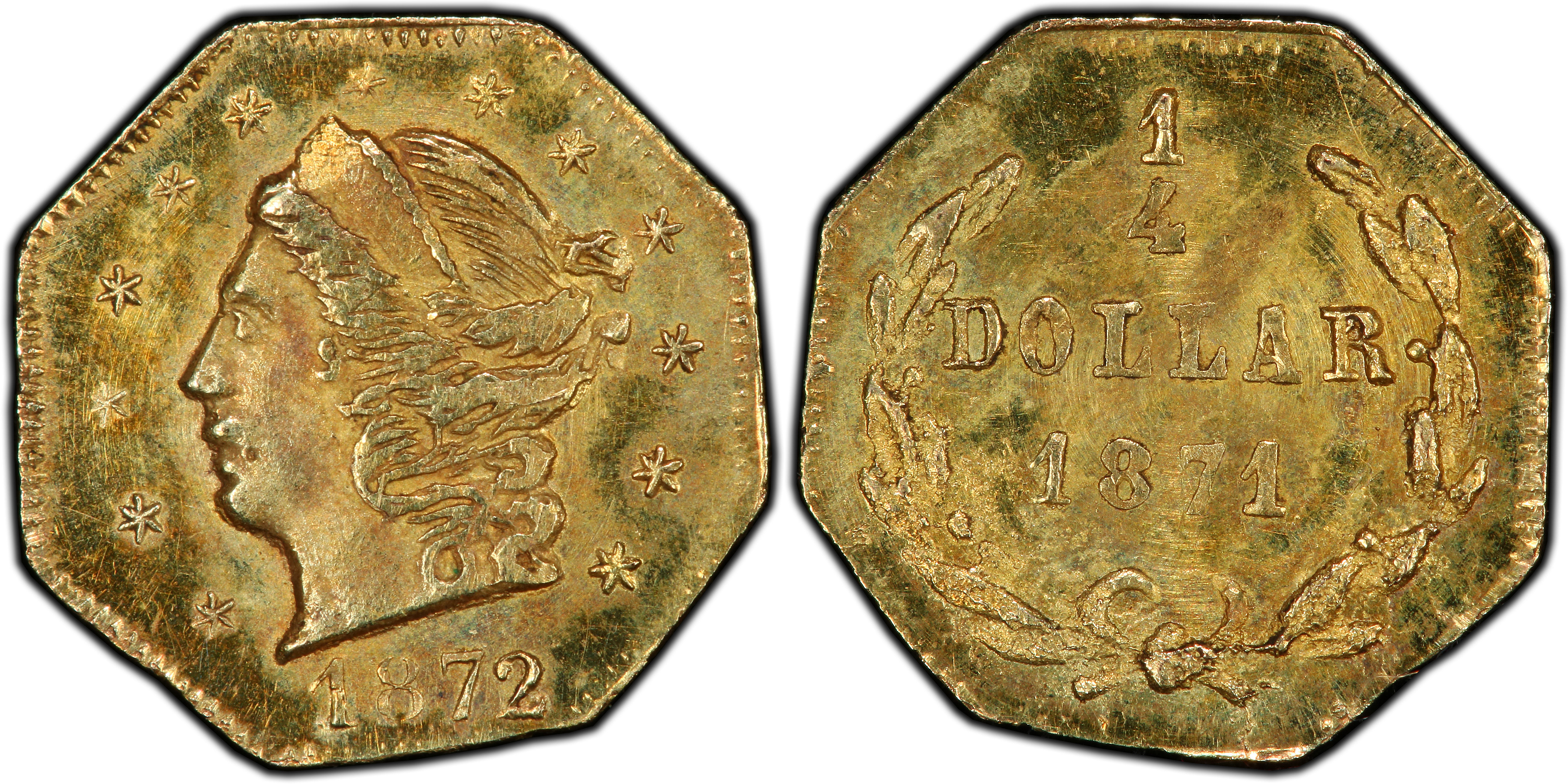
Obverse & Reverse
The 1872 25C BG-721 is a product of the second major phase of California Fractional Gold production (1858-1882), a period numismatically distinct from the initial 'Period One' (1852-1857) issues. While the earlier pieces were struck to genuinely alleviate a shortage of small-denomination coinage in the isolated California economy, the Period Two issues served a different purpose. By the 1870s, the San Francisco Mint was in full operation, and the acute need for private coinage had subsided. Instead, these small gold pieces were primarily manufactured as souvenirs, keepsakes for tourists, and jewelry items, capitalizing on the romantic allure of the California Gold Rush that still captivated the nation. The year 1872 falls squarely in this era of commercial production by various jewelers. These minters, often working in anonymity to avoid potential legal issues following the Private Coinage Act of 1864, created a vast array of designs. The BG-721, like its contemporaries, was not intended to meet a specific economic demand for circulating currency but rather a commercial demand for charming mementos of the Golden State. Their low intrinsic value, typically far below their face value, was irrelevant to their function as novelties. The sheer variety of dies and the often-crude manufacturing techniques, such as hammer striking, are characteristic of this period, suggesting a decentralized and competitive market among San Francisco's jewelers. These pieces are a tangible link to the post-Gold Rush tourism boom and the enduring mythology of the West.
Associated EventCalifornia Gold Rush Aftermath & Tourism
Reason For MintingPrimarily struck for use as souvenirs and jewelry items for the tourist trade, not to fill a circulating coinage need.
Minter HistoryThe specific minter of BG-721 is unconfirmed, which is common for Period Two issues. Many San Francisco jewelers, such as Robert B. Gray & Co., Christopher Mohrig, and others, were active during this time. They often used shared or copied design elements (hubs), and frequently left their products unmarked to avoid prosecution under the Private Coinage Act of 1864, which made producing private currency illegal. This has made the precise attribution of many Breen-Gillio varieties to a specific maker a significant challenge for numismatic researchers.
Historical SignificanceThe BG-721 is significant not as a coin used in daily commerce, but as a historical artifact representing the commercialization of the Gold Rush legacy. It illustrates a shift from necessity-driven private coinage to novelty-driven production, reflecting California's evolving economy and its burgeoning identity as a tourist destination.
BG-721
Denomination25C
Minting Period1872
Assayer/MinterUnknown Jeweler
Geographic OriginSan Francisco, California
Obverse DescriptionA central bust of a Liberty Head facing left, with hair tied in a bun. The portrait is encircled by 13 stars.
Obverse InscriptionNo textual inscription, only the date 1872 below the bust.
Reverse DescriptionThe reverse features the denomination '1/4' surrounded by an open wreath of leaves and berries tied with a bow at the bottom. The word 'DOLLAR' and 'CAL' are typically not present on this variety's reverse design itself, which centers on the wreath and fraction.
Reverse Inscription1/4
CompositionGold
Stated Fineness Actual FinenessVariable, but typically low fineness (e.g., 10-14 karat) for Period Two issues.
Weight0.25 grams
Diameter10.00 mm
EdgePlain
Unknown
Survival EstimateFewer than 100
Rarity ScaleR-6 (13-30 known)
This coin appeals to specialists in the vast and complex series of California Fractional Gold. Its allure lies in the challenge of attribution, the historical context of post-Gold Rush California, and its status as an affordable entry point into the broader field of pioneer gold. The octagonal shape is a classic feature of the series that collectors find particularly attractive.
Key VarietiesBG-721 is itself a specific die variety. The primary variations in the broader 1872 25C series include octagonal vs. round planchets, Liberty vs. Indian vs. Washington head designs, and numerous minor die differences in the placement of stars, dates, and wreath elements cataloged meticulously in the Breen-Gillio reference. No special collector restrikes or patterns are known for this specific variety.
Authentication TipsAuthenticity is a major concern for this series. Genuine examples often exhibit a crude, slightly irregular strike from being hammer-struck. The details, especially the stars, may appear soft. Look for characteristic die markers if available in reference materials. Counterfeits or modern replicas are common; many are gold-plated base metal and may feel light or have a soapy, cast-like appearance. A key diagnostic for many genuine Period Two pieces is the presence of fine, concentric die polishing lines (lathe marks) on the fields, which are often absent on fakes.
Shopping ConsiderationsA premium quality example for this issue is defined by a sharp strike, especially on Liberty's hair details and the numerals of the date. Seek out pieces with minimal contact marks and original, uncleaned surfaces that may exhibit a slightly reddish or orange-gold patina. Avoid specimens that have been harshly cleaned, which will appear unnaturally bright and show hairlines under magnification. Many pieces were formerly used as jewelry, so check carefully for evidence of solder, rim filing, or repaired holes, which drastically reduce numismatic value.
A coin's grade is its condition, rated on a 1-70 scale. For rare coins, this is the most critical factor in determining value, as a tiny difference in preservation can mean a huge difference in price.
Relevant Grade TypesOriginal issues were business strikes, although their primary purpose was for sale as novelties rather than circulation. They are found in Circulated (1-58) and Mint State (MS, 60-70) grades. No proofs were struck during the original period of issue, and no later-date official restrikes exist for this private issue.
Mint State CharacteristicsAn uncirculated BG-721 will exhibit frosty, original luster in the protected areas around the devices. The strike is often somewhat weak, particularly on the highest points of the hair and the stars. The fields are not always perfectly flat and may show the aforementioned lathe marks from die preparation. Small planchet flaws or strike-throughs are not uncommon given the rudimentary minting process. Bag marks are less common than on larger coins, but small contact marks from handling are typical.
Circulated Wear PatternsWear first appears on the high points of Liberty's cheek, ear, and the hair above the eye. On the reverse, the leaves and the bow of the wreath will show the first signs of friction. In lower grades (VF and below), the stars will begin to merge with the field, and the date can become faint.
Key Factors For ValueFor the BG-721, the primary value drivers are grade and surface quality. A sharp, well-centered strike commands a significant premium. Original, untouched surfaces with attractive toning are highly prized over cleaned or polished examples. Eye appeal is paramount; a coin with fewer distracting marks will always be more desirable. Given the prevalence of counterfeits, certification by a top-tier grading service (PCGS or NGC) is nearly essential for ensuring authenticity and market liquidity. A CAC sticker for this issue would indicate premium quality for the grade and would add a significant premium.
PCGS Price Guide
| Grade | Price | Population |
|---|---|---|
| 61 | $3,250.00 | 1 |
| 62 | $4,500.00 | 1 |
| 62+ | $6,500.00 | N/A |
| 63 | $12,000.00 | 1 |
| 63+ | $12,500.00 | N/A |
| 64 | $13,500.00 | N/A |
| 64+ | $14,000.00 | N/A |
| 65 | $15,000.00 | 2 |