No Date G25C BG-204 (Regular Strike)
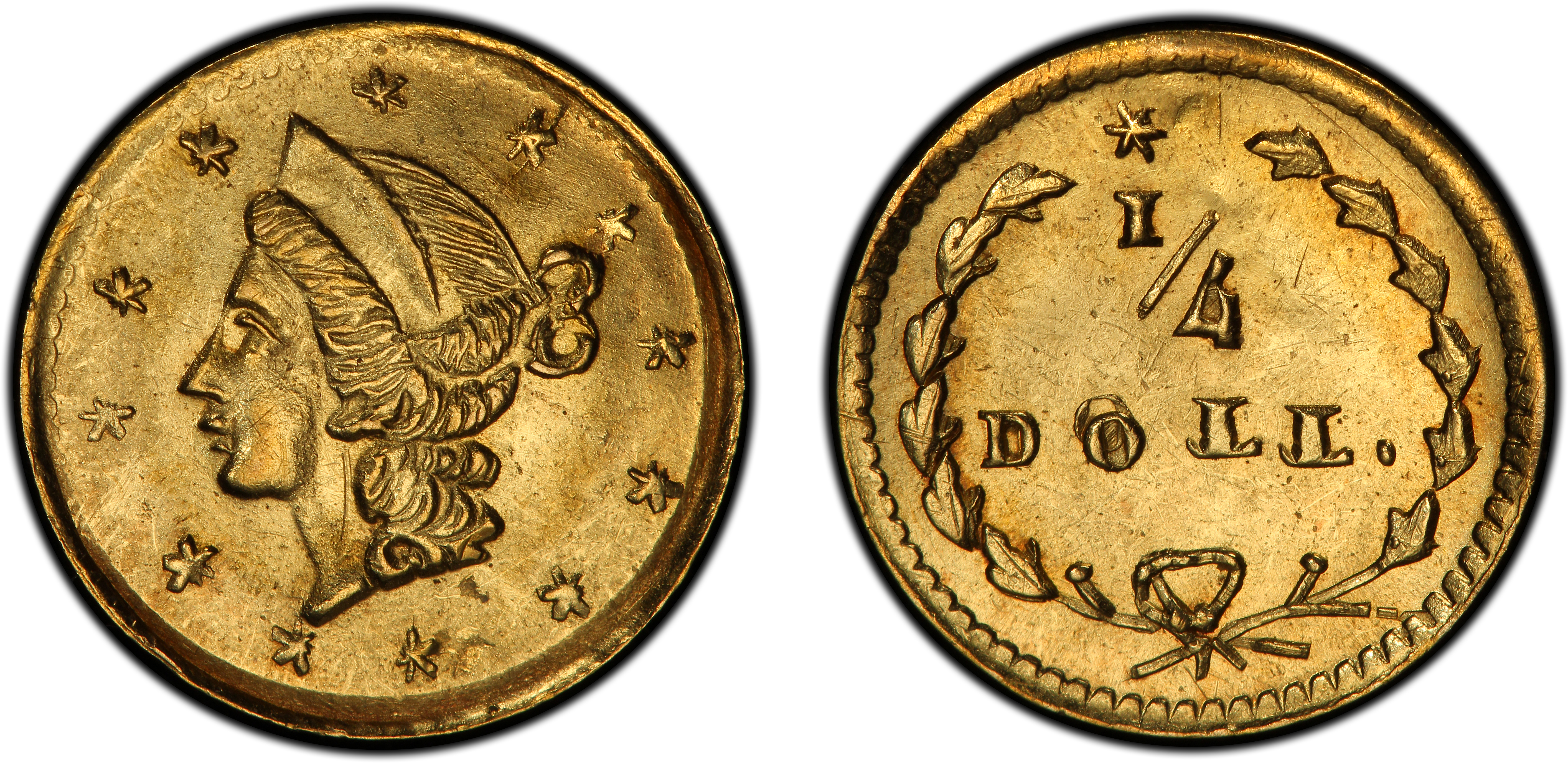
Obverse & Reverse
The BG-204 25 Cents is a quintessential artifact of the socio-economic turmoil and ingenuity that defined the California Gold Rush. The discovery of gold at Sutter's Mill in 1848 triggered a massive migration, swelling California's population and creating bustling commercial centers overnight. While gold dust was plentiful, official U.S. coinage was critically scarce. Daily transactions for necessities like food, lodging, and tools were severely hampered. A 'pinch' of gold dust, a common measure, was notoriously inaccurate and prone to disputes. This acute shortage of small change created a vacuum that private enterprise rushed to fill. Jewelers and metalworkers in San Francisco, many of them recent French immigrants with metallurgical skills, began striking their own small-denomination coins. These 'California Fractional Gold' pieces, including the BG-204, were not government-sanctioned but were tolerated out of sheer necessity. The BG-204 is classified as a 'Period One' issue (1852-1857), a designation for the earliest fractionals that most closely emulated the weight and design standards of federal coinage and are believed to have genuinely circulated. These tiny coins facilitated everyday commerce, allowing miners and merchants to conduct business with greater ease. Unlike the later 'Period Two' and 'Three' pieces, which were often underweight and intended as souvenirs, the BG-204 was a workhorse coin of the Gold Rush economy. Its existence demonstrates the adaptation of a frontier society, creating its own financial instruments in the absence of federal infrastructure. The eventual establishment of the San Francisco Mint in 1854 and its full-scale production by 1856 gradually rendered these private issues obsolete, and most were eventually melted down, ensuring the rarity of survivors like the BG-204.
Associated EventCalifornia Gold Rush
Reason For MintingTo alleviate a severe shortage of small-denomination coinage for daily commercial transactions in Gold Rush-era California.
Minter HistoryAntoine Louis Nouizillet was a French jeweler and one of the most prolific private minters in Gold Rush San Francisco. Arriving amidst the boom, he applied his trade to the pressing local need for coinage. He operated both independently and in partnerships, such as 'Deriberpe and Nouizillet' (D.N.) and 'Nouizillet and Routhier' (N.R.). While many Period One issues are unmarked, stylistic analysis and die links attribute numerous varieties, including the BG-204, to his hand. His work is characteristic of the Period One ethos: designs that were inspired by, but not direct copies of, federal issues, struck with a functional rather than ornate purpose. Around 1859-60, Nouizillet sold his business to Robert B. Gray & Co., which continued to use some of his dies.
Historical SignificanceThe BG-204 is a tangible link to the primitive, ad-hoc economy of the California Gold Rush, representing a period before federal institutions could keep pace with westward expansion. It is a prime example of a 'Period One' fractional, struck for circulation out of necessity, making it a more historically significant piece than the later souvenir issues. Its survival testifies to the vibrant, chaotic, and ultimately self-sufficient commercial environment of mid-19th century San Francisco.
K-N/A
Denomination25 Cents
Minting Periodc. 1853
Assayer/MinterAntoine Louis Nouizillet (Attributed)
Geographic OriginSan Francisco, California
Obverse DescriptionThe obverse features a well-engraved, left-facing portrait of Liberty, stylistically similar to the contemporary federal gold dollar, but with distinct features characteristic of private minters. Her hair is tied in a bun, and she wears a coronet inscribed LIBERTY, though often weakly struck. The portrait is encircled by thirteen six-pointed stars, representing the original colonies, which are often crudely punched and unevenly spaced.
Obverse Inscription Reverse DescriptionThe reverse is dominated by a simple wreath composed of two branches tied by a bow at the bottom. Inside the wreath, the denomination is expressed as '1/4 DOLLAR'. A key diagnostic for this variety is a clearly double-punched 'O' in 'DOLLAR'. The legend CALIFORNIA GOLD often appears around the periphery, though its presence and clarity can vary based on strike quality.
Reverse Inscription1/4 DOLLAR CALIFORNIA GOLD
CompositionGold
Stated Fineness Actual Fineness EdgePlain
Unknown
Survival Estimate31-75
Rarity ScaleR-5
The BG-204 is highly sought after as a representative 'Period One' issue, valued for its historical role in actual Gold Rush commerce. Its specific Breen-Gillio variety, defined by its unique dies, appeals to specialists. The combination of historical significance, high rarity (R-5), and the charm of its crude yet classic design makes it a prize for collectors of Territorial gold and Western Americana.
Key VarietiesThe primary variety is the BG-204 itself, defined by its specific obverse and reverse die pairing. Within the broader 'No Date G25C' category, Breen-Gillio identifies other related varieties (BG-203, BG-205, etc.) made by different dies, each with its own diagnostics and rarity. No later-date restrikes or special collector issues are known for the BG-204 die state.
Authentication TipsAuthentic examples will have a slightly crude, hand-struck appearance, not a modern, machine-made look. The specific diagnostic for BG-204 is the prominently double-punched 'O' in DOLLAR on the reverse; this should not look like simple machine doubling. The gold should have the color and density of genuine Gold Rush-era bullion, often with a slightly lower fineness than federal issues. Modern fakes are often underweight, brassy in color, or have mushy, ill-defined details. Compare any potential purchase against high-resolution images of certified examples.
Shopping ConsiderationsFor a premium quality BG-204, look for a sharp strike, especially on Liberty's coronet and the details of the reverse wreath. Luster is a key value component; examples with original, satiny mint luster command significant premiums. Given their use in circulation, many specimens are found in lower grades; a problem-free, circulated example with honest wear is still highly desirable. Avoid coins that have been harshly cleaned, which strips the original surface and imparts a dull or unnaturally bright appearance. Also, inspect for evidence of being mounted in jewelry, such as solder marks, tooling, or rim damage, which drastically reduces the value.
A coin's grade is its condition, rated on a 1-70 scale. For rare coins, this is the most critical factor in determining value, as a tiny difference in preservation can mean a huge difference in price.
Relevant Grade TypesOriginal BG-204 issues were business strikes intended for circulation and are found in Circulated (1-58) and Mint State (MS, 60-70) grades. No Proofs were struck during the original minting period, as these were utilitarian coins. Any piece described as a 'Proof' would not be an original striking and should be regarded with extreme skepticism.
Mint State CharacteristicsUncirculated examples of BG-204 are very rare. Quality is defined by the strength of the strike; many were crudely struck by hand using a hammer, resulting in areas of weakness, particularly at the centers or peripheries. Luster is typically soft and satiny rather than deeply prooflike or frosty. Due to the softness of the gold and the primitive minting process, even Mint State examples will typically show some light planchet flaws or tiny contact marks that do not impede the grade.
Circulated Wear PatternsWear first appears on the highest points: Liberty's cheek, the hair above her eye, and the coronet. On the reverse, the highest points of the wreath leaves and the bow will show initial friction. On moderately worn examples (VF), significant detail in the hair and wreath will be lost. In lower grades (F and below), the stars on the obverse will begin to merge with the field, and the legends will become soft.
Key Factors For ValueFor the BG-204, rarity is a given, so value is driven almost entirely by condition and eye appeal. A sharply struck coin with minimal marks and original, uncleaned surfaces will always bring a premium. Rich, reddish-gold or honey-gold toning that indicates originality is highly prized by collectors. Problem-free surfaces are paramount; coins without scratches, rim bumps, or signs of cleaning are worth substantially more. A CAC sticker for this issue is a strong endorsement of quality for the grade and typically adds a significant premium.
PCGS Price Guide
| Grade | Price | Population |
|---|---|---|
| 15 | $250.00 | 1 |
| 20 | $260.00 | N/A |
| 25 | $270.00 | N/A |
| 30 | $280.00 | N/A |
| 35 | $290.00 | N/A |
| 40 | $300.00 | N/A |
| 45 | $310.00 | 1 |
| 45+ | $320.00 | N/A |
| 50 | $335.00 | N/A |
| 50+ | $350.00 | N/A |
| 53 | $360.00 | N/A |
| 53+ | $375.00 | N/A |
| 55 | $400.00 | 3 |
| 55+ | $420.00 | N/A |
| 58 | $450.00 | 5 |
| 58+ | $475.00 | N/A |
| 60 | $575.00 | 2 |
| 61 | $625.00 | 4 |
| 62 | $850.00 | 11 |
| 62+ | $1,000.00 | N/A |
| 63 | $1,350.00 | 10 |
| 63+ | $1,650.00 | N/A |
| 64 | $2,750.00 | 3 |