1853 G$1 BG-514 (Regular Strike)
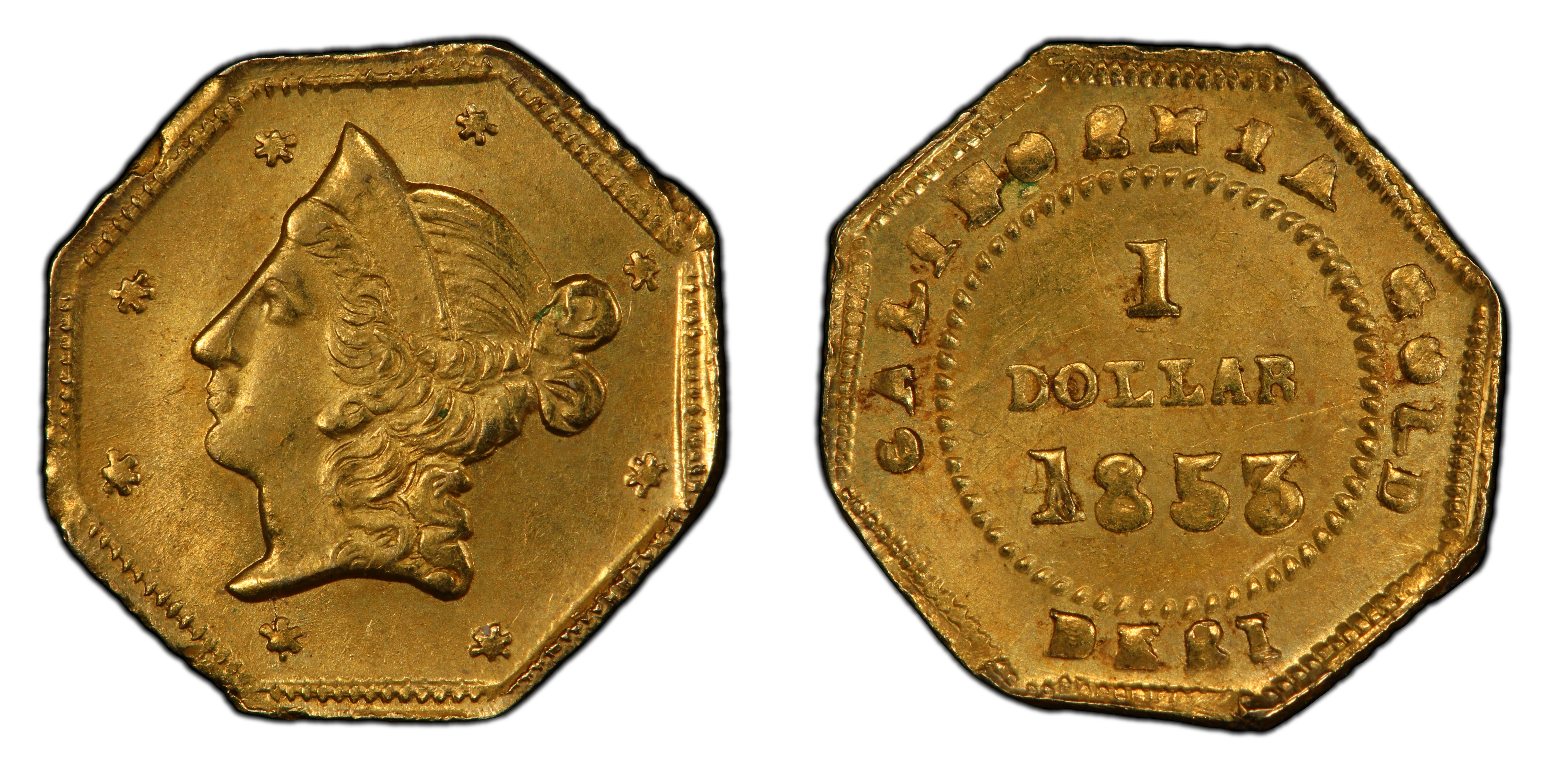
Obverse & Reverse
The 1853 BG-514 octagonal gold dollar emerged from the chaotic and economically fertile ground of the California Gold Rush. After the initial discoveries in 1848, a flood of gold dust and nuggets overwhelmed the region's primitive economy, but there was a severe shortage of official United States coinage for everyday transactions. Gold dust, weighed imprecisely in 'pinches,' was an impractical and often inequitable medium of exchange. This created a vacuum filled by private minters—often jewelers or metalworkers by trade—who began striking coins from native California gold. These 'Period One' (1852-1857) issues, including the BG-514, are considered the most legitimate of the fractional gold series, as they were produced out of genuine commercial necessity before the San Francisco Mint began full-scale operations in 1854-1856. Unlike later 'souvenir' issues, these early fractionals were intended to and did circulate, facilitating minor commerce in the boomtowns. The BG-514, with its bold, somewhat crude 'Defiant Eagle' design, is a quintessential example of this period. Struck by hand, these pieces were often slightly underweight but were accepted at face value due to the urgent need for a circulating medium. Their production was a direct response to the failure of the federal government to supply adequate coinage to its newest and most dynamic territory. While the exact maker is not definitively known, stylistic similarities and historical context strongly point to Antoine Louis Nouizillet, a French jeweler in San Francisco. The eventual establishment of the federal mint and the passage of laws in 1864 banning private coinage marked the end of this fascinating chapter, cementing the status of these early fractionals as tangible relics of Gold Rush ingenuity and necessity.
Associated EventCalifornia Gold Rush
Reason For MintingTo alleviate a severe shortage of small-denomination coinage for daily commerce in Gold Rush-era California before the San Francisco Mint was fully operational.
Minter HistoryWhile not definitively signed, the BG-514 is widely attributed to Antoine Louis Nouizillet, a French jeweler who operated a private mint in San Francisco during the early 1850s. Like many of his contemporaries, Nouizillet leveraged his metallurgical skills to meet the public's desperate need for coinage. He is known to have produced a variety of fractional gold denominations, often marked with his initials 'N' or 'NL'. The pieces attributed to him are characterized by a consistent, if somewhat primitive, artistic style, reflecting the conditions under which they were hastily produced.
Historical SignificanceThe BG-514 is a key representative of the 'Period One' California Fractional Gold series, valued by numismatists as a genuine circulating medium from the height of the Gold Rush. It represents a grassroots solution to a systemic economic problem and is a direct physical link to the commerce of the mining camps and boomtowns. Its existence highlights the lag between westward expansion and the establishment of federal infrastructure, forcing pioneers to create their own economic instruments.
N/A
Denomination$1
Minting Period1853
Assayer/MinterProbably Antoine Louis Nouizillet
Geographic OriginSan Francisco, California
Obverse DescriptionA fairly crude depiction of a Liberty Head facing left, her hair tied in a bun. She is surrounded by thirteen stars of varying quality, with the date 1853 below. The portrait features a prominent, sharp nose and chin. The planchet is octagonal.
Obverse Inscription1853
Reverse DescriptionA defiant-looking eagle with outstretched wings, head turned to its right, clutching branches and arrows. The inscription 'CALIFORNIA GOLD' appears above the eagle along the upper facets of the octagon. The denomination '1 D.' is below the eagle. The style of the eagle is unique and somewhat primitive compared to federal issues.
Reverse InscriptionCALIFORNIA GOLD / 1 D.
CompositionGold
Stated Fineness Actual FinenessTypically around .800 to .880 fine, alloyed with native silver and copper.
Diameter14.30 mm
EdgePlain
Unknown
Survival Estimate50-75
Rarity ScaleR-5
This coin is highly sought after for its direct connection to the California Gold Rush, its distinctive octagonal shape, and its charismatic 'Defiant Eagle' design. As a 'Period One' issue, it is prized for its historical legitimacy as a circulating coin, unlike many later souvenir pieces. Its crude, handmade quality imparts a unique historical charm.
Key VarietiesThe BG-514 is a specific die marriage and is considered a 'regular strike' for circulation. No proof or presentation strikings from the period of issue are known to exist. Later restrikes or copies by other manufacturers exist for the broader category of fractional gold, but are distinct from this original 1853 issue. Collectors should be aware of contemporary counterfeits and much later souvenir productions that mimic this design.
Authentication TipsAuthentic examples have a characteristic soft, slightly brassy gold color from the native alloy. The strike is often uneven, with some elements sharp and others weak. Look for die cracks, which are common on genuine specimens; a known reverse die crack often extends from the rim through the 'F' of CALIFORNIA. Counterfeits are plentiful and may be underweight, have incorrect lettering fonts, or exhibit a soapy, cast-like appearance. Compare against high-resolution images of certified examples.
Shopping ConsiderationsA premium quality example for its grade will possess a strong, relatively centered strike on both sides. Look for minimal distracting marks on the central design elements and in the fields. Original, uncleaned surfaces with some remaining luster command significant premiums. Avoid examples that have been harshly cleaned, polished, or used as jewelry, as these issues are common and drastically reduce value. The sharpness of the eagle's head and the date are key focal points to assess strike quality.
A coin's grade is its condition, rated on a 1-70 scale. For rare coins, this is the most critical factor in determining value, as a tiny difference in preservation can mean a huge difference in price.
Relevant Grade TypesOriginal 1853 BG-514 issues were business strikes intended for circulation and are found in Circulated (1-58) and, very rarely, Mint State (MS, 60-70) grades. No Proofs (PR/PF) were struck during the original minting period. Any piece described as a 'Proof' would be a later restrike, fantasy piece, or modern copy and should be considered a completely separate numismatic item.
Mint State CharacteristicsUncirculated examples are extremely rare. A true MS specimen would exhibit full, frosty, or satiny luster, though the quality may be slightly subdued due to the gold alloy. The strike is almost never perfectly sharp across the entire coin; weakness on the stars opposite the high points of Liberty's head is typical. Small, planchet-related flaws or adjustment marks made prior to striking are common and should not be confused with post-striking damage.
Circulated Wear PatternsWear first appears on the highest points: Liberty's cheek, hair bun, and the tip of her coronet on the obverse. On the reverse, the eagle's head, the upper parts of the wings, and its breast are the first areas to show flatness. On lower grade examples, the date and the finer details of the eagle's feathers will become faint or disappear entirely.
Key Factors For ValueFor the BG-514, value is driven by several key factors. Firstly, surface preservation is paramount; an example with original, uncleaned 'skin' is vastly superior to a cleaned or polished coin of the same grade. Secondly, the quality and evenness of the strike are critical; well-centered coins with strong details on the Liberty portrait and the eagle command a premium. Eye appeal, which includes attractive original toning and a lack of distracting marks, is a major consideration. Finally, certification by a top-tier grading service (PCGS or NGC) is essential for market acceptance, with a CAC sticker adding a further premium for coins deemed high-end for their grade.
PCGS Price Guide
| Grade | Price | Population |
|---|---|---|
| 4 | N/A | N/A |
| 20 | N/A | N/A |
| 50 | $600.00 | 1 |
| 50+ | $675.00 | N/A |
| 53 | $750.00 | 3 |
| 53+ | $800.00 | N/A |
| 55 | $850.00 | 4 |
| 55+ | $925.00 | N/A |
| 58 | $1,000.00 | 9 |
| 58+ | $1,075.00 | N/A |
| 60 | $1,150.00 | 1 |
| 61 | $1,250.00 | 3 |
| 62 | $1,550.00 | 11 |
| 62+ | $1,800.00 | N/A |
| 63 | $2,350.00 | 7 |
| 63+ | $2,750.00 | N/A |
| 64 | $3,000.00 | 8 |
| 64+ | $4,250.00 | N/A |
| 65 | $8,000.00 | 2 |