1871 G25C BG-717 (Regular Strike)
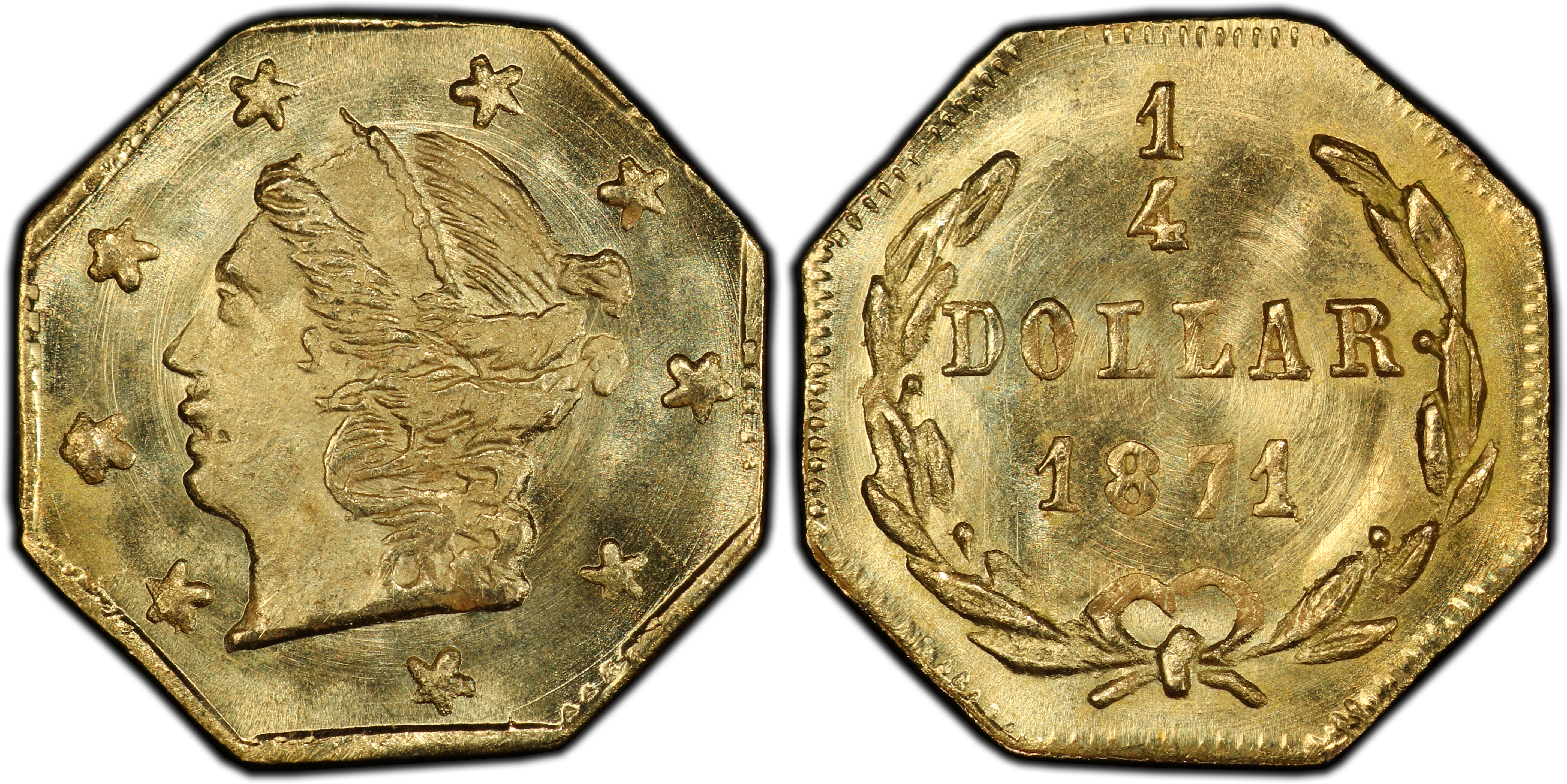
Obverse & Reverse
The 1871 BG-717 25 Cents represents a fascinating chapter in the evolution of California's privately issued gold coinage. By 1871, the initial, desperate need for circulating coinage that characterized the Gold Rush's peak in the early 1850s had long subsided. The San Francisco Mint, opened in 1854, was producing ample federal coinage for daily commerce. This shifted the role of private minters. The first wave of 'Period One' (1852-1857) fractional gold pieces were struck out of necessity to facilitate small transactions in an economy flooded with gold dust but starved for small change. By the time the 'Period Two' (1858-1882) issues like the BG-717 appeared, their purpose was primarily commercial and souvenir-driven. Jewelers and private minters in San Francisco, many of French origin, recognized a market for these tiny, attractive gold pieces among locals and tourists who wanted a keepsake of the Golden State's defining industry. Despite the Coinage Act of 1864, which made private coinage illegal, enforcement was lax in the West until the early 1880s. This legal gray area allowed firms like Frontier, Deviercy & Co. (the presumed makers of this piece) to continue production. These tokens were not intended to pass at face value in gold content; their intrinsic worth was substantially less than 25 cents, making them profitable novelties. The BG-717 variety, with its classic Liberty Head motif mimicking federal designs, was produced in relatively large quantities for the series, indicating its popularity as a commercial item. These pieces were often sold in sets or individually, capturing the romanticism of the Gold Rush era for a new generation, long after the placer mines had given out.
Associated EventPost-Gold Rush Economic Expansion
Reason For MintingPrimarily produced as a popular and commercially viable souvenir or keepsake of the California Gold Rush era for locals and tourists.
Minter HistoryWhile attribution is not definitive, the BG-717 is widely believed to have been struck by Frontier, Deviercy & Co., a prominent San Francisco jewelry firm. This company was a prolific producer of 'Period Two' California fractional gold. These 'jeweler's issues' are characterized by a departure from the urgent, utilitarian nature of the earlier Period One coins. Instead, they were crafted with a commercial audience in mind, serving more as tokens and souvenirs than as essential circulating currency. The workmanship on these pieces varies but often displays a consistent, albeit sometimes crude, style that became familiar in the San Francisco market of the 1860s and 1870s.
Historical SignificanceThe BG-717 is emblematic of the 'Period Two' phase of California Fractional Gold, highlighting the transition from necessity-driven private coinage to commercial souvenir production. Its existence demonstrates the continued romantic appeal of the Gold Rush and the legal ambiguities that allowed private minting to persist for nearly two decades after it was federally outlawed. As one of the more common varieties, it serves as an accessible entry point for collectors into this complex and historic series.
N/A
Denomination25 Cents
Minting Period1871
Assayer/MinterProbably Frontier, Deviercy & Co.
Geographic OriginSan Francisco, California
Obverse DescriptionA crudely rendered Liberty Head, facing left, mimicking the design of contemporary federal gold coinage. The portrait features a broad head, often with an incomplete or weakly struck nose. Thirteen stars, representing the original colonies, encircle the portrait.
Obverse Inscription[No inscription, only stars and portrait]
Reverse DescriptionThe denomination '1/4 DOL.' is enclosed within a wreath of leaves and berries. The wreath is open at the top. A key diagnostic for the variety is a large berry often seen attached to the inside of the wreath near the 'R' in the word 'QUARTER' if it were spelled out.
Reverse Inscription1/4 DOL.
CompositionGold
Stated Fineness Actual FinenessVariable, but generally a lower fineness than federal issues, consistent with token coinage.
Weight0.25 grams
Diameter9.80 mm
EdgePlain
Unknown, but considered one of the more common Period Two varieties.
Survival Estimate201-500 known (per PCGS)
Rarity ScaleR-3 to R-4
This coin is popular as a widely available and relatively affordable example of an octagonal California Fractional Gold piece. Its clear date, denomination, and classic Liberty Head design make it a representative type coin for the entire series, appealing to both beginners and seasoned specialists.
Key VarietiesThe primary variety is the Regular Strike. A Prooflike (PL) version is also designated by grading services, representing pieces struck from freshly polished dies that exhibit mirrored fields. There are no known major die varieties from the original minting period, nor are there any known later-date restrikes or patterns associated with BG-717.
Authentication TipsGenuine examples often show a characteristically weak strike on the bridge of Liberty's nose and crudely executed stars. The reverse wreath should be carefully compared to known genuine examples, paying attention to the leaf and berry placement. Counterfeits may be of incorrect weight, have a soapy or cast-like texture, or exhibit incorrect design details. Many modern replicas exist, often made of brass or low-karat gold; these typically lack the sharpness and specific die characteristics of genuine pieces.
Shopping ConsiderationsA premium quality example for its grade will exhibit a sharp strike, especially on the stars and the details of the wreath. Look for pieces with clean, original surfaces that have not been harshly cleaned or polished, as this is a common issue. Deeply prooflike (PL) or semi-prooflike examples command a significant premium and are highly sought after for their eye appeal. Check for planchet flaws or laminations, which are occasionally seen but should be minor. Avoid coins that have been holed or used in jewelry, unless purchased strictly as a filler piece.
A coin's grade is its condition, rated on a 1-70 scale. For rare coins, this is the most critical factor in determining value, as a tiny difference in preservation can mean a huge difference in price.
Relevant Grade TypesOriginal 1871 BG-717 coins were business strikes intended for commercial sale as souvenirs, and are found in Circulated (1-58) and Mint State (MS, 60-70) grades. No true Proofs were struck during the original period of issue. However, coins struck with freshly polished dies may exhibit reflective surfaces and receive a Prooflike (PL) or Deep Prooflike (DPL) designation from grading services; these are not a separate issue but rather a desirable manufacturing variance of the business strike.
Mint State CharacteristicsUncirculated examples of BG-717 are characterized by their luster, which can range from satiny to deeply reflective (prooflike). The strike is a key factor; many are softly struck, particularly on Liberty's nose and the central reverse. High-grade examples will show minimal contact marks, though due to their small size and handling in groups, even MS coins can have tiny ticks. The color of the gold can vary, but attractive, original reddish or greenish-gold toning is prized.
Circulated Wear PatternsWear first appears on the high points of the design: the cheek and hair of Liberty on the obverse, and the leaves and bow of the wreath on the reverse. On moderately worn examples, the stars will begin to lose their definition, and the fraction on the reverse may become faint. In lower grades (VG and below), the date and legends will be weak but should still be mostly legible.
Key Factors For ValueThe primary drivers of value are grade and surface quality. An original, uncleaned coin with minimal marks will always be worth more than a cleaned or damaged one of the same grade. Strike sharpness is critical; a well-struck piece with a full nose on Liberty is rare and commands a premium. Eye appeal, enhanced by prooflike surfaces or attractive original toning, adds significant value. Certification by a top-tier service (PCGS or NGC) is essential for market acceptance, and a CAC sticker for this issue indicates superior quality for the grade and brings a strong premium.
PCGS Price Guide
| Grade | Price | Population |
|---|---|---|
| 50 | $220.00 | 2 |
| 50+ | $225.00 | N/A |
| 53 | $235.00 | N/A |
| 53+ | $240.00 | N/A |
| 55 | $250.00 | 3 |
| 55+ | $260.00 | N/A |
| 58 | $275.00 | 7 |
| 58+ | $285.00 | N/A |
| 60 | $300.00 | 3 |
| 61 | $325.00 | 4 |
| 62 | $350.00 | 33 |
| 62+ | $365.00 | N/A |
| 63 | $380.00 | 47 |
| 63+ | $410.00 | N/A |
| 64 | $450.00 | 66 |
| 64+ | $500.00 | N/A |
| 65 | $575.00 | 48 |
| 65+ | $700.00 | N/A |
| 66 | $1,100.00 | 23 |
| 66+ | $1,400.00 | 1 |
| 67 | $1,700.00 | 10 |
| 67+ | $2,750.00 | 1 |
| 68 | $5,750.00 | 1 |